
Is a Device Cited for Its Test Method Also a Predicate? Two Roles in FDA 510(k) Submissions
Distinguish the substantial-equivalence comparator from a reference supporting test methodology, using a fictional A/B review and applicability questions.
Citing two devices in a 510(k) does not make both of them predicate devices.
A device used for the substantial-equivalence comparison and a device cited to support a test method serve different purposes.
Distinguishing those purposes helps a team decide what belongs in its device comparison and what belongs in its explanation of testing.
This article is for development and regulatory teams preparing a US FDA 510(k).
A predicate device is the comparator to which substantial equivalence (SE) is claimed.
A reference device supports scientific methodology or standard reference values, for example.
It does not replace the predicate.[1,2]
A supports the device comparison; B supports the test-method explanation
Consider a fictional review.
A team identifies device A as a candidate comparator for its new device.
During its research, it also finds that a method used for device B may help evaluate a particular technological characteristic.
This is an explanatory scenario, not a case involving actual product names, clearance numbers or test results.
Before listing A and B as equivalent comparators, the team records why each is cited.
For A, it describes how intended use and technological characteristics will be compared.
For B, it specifies the method of interest and why it may address the new device's evaluation question.
Neither candidate's suitability is established merely by assigning these roles.
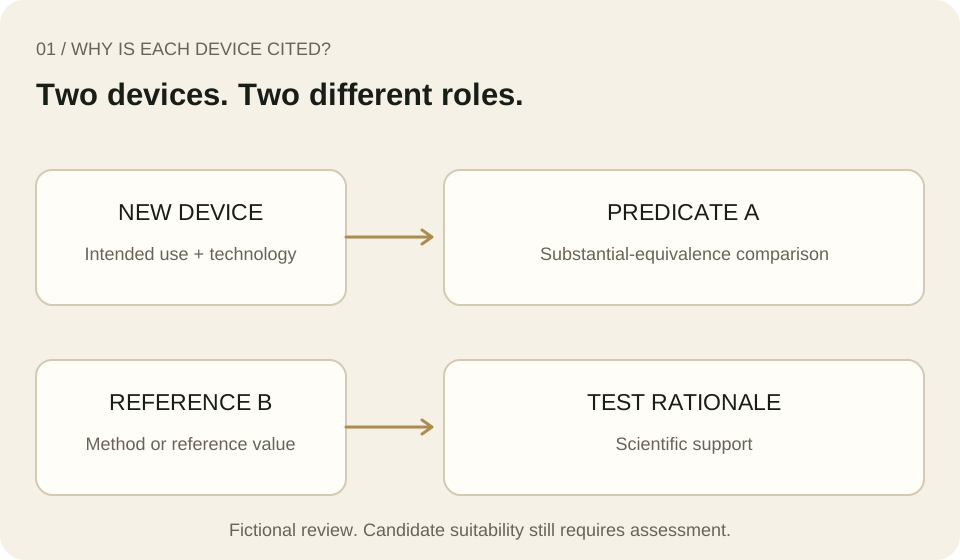
In this fictional review, A is the candidate comparator and B is a candidate source of test-method support.
Their roles in the documentation are kept distinct.
| Review question | Candidate predicate A | Candidate reference B |
|---|---|---|
| Why cite it? | To compare the new device for substantial equivalence | To support a specific method or other scientific basis |
| Which explanation does it support? | Intended use, technological characteristics and assessment of differences | The scope of the referenced method and its applicability |
| What should not be assumed? | A similar appearance or extensive documentation alone makes it suitable | Citing a test method makes B a second predicate |
This table is MedQraft's practical organization of the review, not an FDA submission template or a determination about a specific device.
A reference cannot fill a gap in the earlier predicate assessment
FDA's 2014 final guidance places reference devices at Decision Point 5a, after a manufacturer has successfully navigated through Decision Point 4 using a single predicate.
Reference devices cannot address Decision Points 1 through 4.[2, IV.C.2]
Keep that sequence intact in a review.
The appropriate predicate, same intended use, and whether technological differences raise different questions of safety and effectiveness must be addressed first.
Adding B because its testing is well described does not resolve an unsuccessful earlier assessment.
The diagram below simplifies the position of reference devices; it does not replace FDA's complete decision-making flowchart.
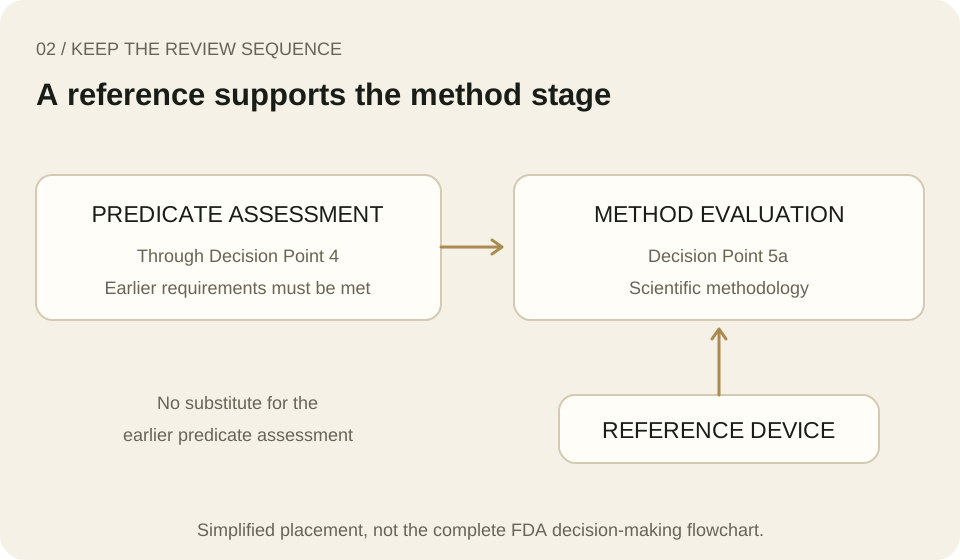
A reference does not replace the earlier predicate assessment.
This original diagram simplifies its role after Decision Point 4, at Decision Point 5a.
The split-predicate approach, using one device for intended use and a different device for technological characteristics to establish substantial equivalence, is inconsistent with FDA's regulatory standard.
Using multiple predicates in appropriate circumstances is a separate concept from using reference devices.[1,2] The presence of two device names alone therefore does not identify a multiple-predicate or split-predicate approach.
The role assigned to each device matters.
Applying B's test method to the new device
Rather than jumping from “B used this test” to a test plan, define what is being referenced.
It may be a measurement method, the rationale for conditions, or a particular reference value.
Then examine whether differences in the new device affect interpretation.
FDA calls for a scientific rationale for using a reference device and reviews its appropriateness.[2]
For example, suppose the team is considering a method used to assess a surface characteristic of B.
Even where the characteristic appears similar, differences in specimen geometry, materials, measurement location or use environment may change the method's applicability.
Which differences can be accommodated and which need separate evaluation depend on the testing purpose.
This is an original fictional example, not a recommendation for a particular method or acceptance criterion.
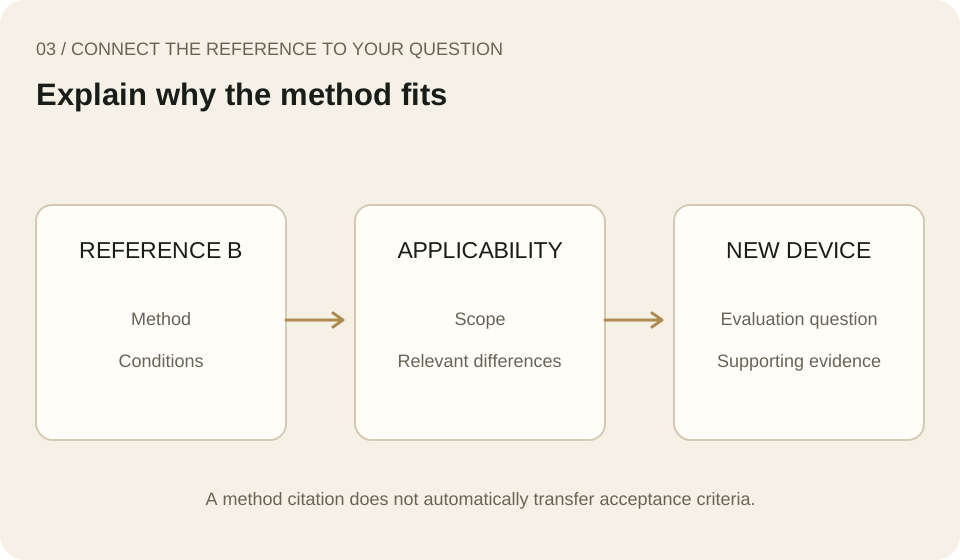
Connect B's method to the new device's evaluation question instead of transferring it without justification.
The review items are practical suggestions to adapt to the device and test purpose.
Keeping the following items in one record makes the reasoning easier to trace.
| Record item | Fictional entry |
|---|---|
| Evaluation question | How should a particular surface characteristic of the new device be evaluated? |
| What is referenced from B | The measurement method and explanation of test conditions |
| Differences from the new device | Materials, geometry and measurement location, and their possible effect on results |
| Applicability decision and follow-up | Supported scope, conditions to change and additional validation information needed |
Using a reference does not automatically waive testing of the new device or justify copying B's values and acceptance criteria.
The conclusion sought for the new device still needs supporting information.
A reference device is not mandatory in every 510(k).
Record the citation's purpose before its device name becomes a label
At the start of a review, write a sentence beside each candidate: “A is a candidate comparator for substantial equivalence” and “B is a candidate reference supporting this particular evaluation method.”
Then determine whether the available information supports those roles.
If a role changes, update the comparison and testing explanation accordingly.
The useful outcome is a traceable comparison and evidence rationale, rather than a long list of devices.
For the predicate, show what is the same and different.
For the reference, show what is borrowed as support and why it is applicable.
Actual suitability requires review of the intended use, technological characteristics and submission information.
Related reading
- FDA registration and listing versus device marketing authorization: distinguishing terms that serve different purposes in the US process.
- What to establish before a global market submission: connecting the target market and product conditions to submission preparation.
Sources and scope
- FDA, How to Find and Effectively Use Predicate Devices, Introduction and How to Effectively Use Predicate Devices.
- FDA, The 510(k) Program: Evaluating Substantial Equivalence in Premarket Notifications [510(k)], final guidance issued July 28, 2014.
Relevant portions of IV.C, especially IV.C.2 Reference Devices (printed pages 13 to 14), IV.C.4, Appendix A and Appendix D.
Official sources checked October 23, 2026.
This article explains roles within the US 510(k) process.
The guidance itself contains nonbinding recommendations; distinguish these from legal requirements and individual review decisions.
The dialogue, A/B scenario, tables and three diagrams are original MedQraft explanations.
No source table or diagram has been reproduced.
Let's talk
Apply what you have read
to your product.
Tell us your product's current stage and the questions you need to review.
Discuss your questions ↗