
MedQraft
← All insights
Human tissues & biomaterials

ISO 10993-1:2025 Revision: Material-Mediated Pyrogenicity Beyond the Table

The change from tables to text, evaluation conditions in 6.5.10.5, and judgments about additional testing for material-mediated pyrogenicity.

Last regulatory review: 2026-10-19 Rev. 1.0 7 min read

The absence of material-mediated pyrogenicity (MMP) from the biological effects tables in ISO 10993-1:2025 does not automatically justify removing it from a product's evaluation plan.
The revised edition addresses it under “other biological effects.”
Clause 6.5.10.5 describes circumstances requiring evaluation and the use of a justification.
FDA's official September 2026 presentation identifies this change and publicly quotes the clause.
[1, slides 9 and 21]

This article focuses on that single change.
Contact categorization, including skin and blood contact, and implantation control selection are covered separately in earlier articles.
Here, the question “Is it in the table?” is followed by “What conditions does the text address?”

Read the table change together with the text

ISO identifies the 2025 edition as the sixth edition, published in November 2025.
Its revision includes structural alignment with the ISO 14971 risk management process.
This does not mean that risk-based evaluation was introduced for the first time.
[2]

FDA's comparison explains that MMP, previously addressed in the tables, is now addressed under other biological effects.
Comparing only the rows of the two editions and marking an item “deleted” can miss the conditions addressed in the text.
[1, slide 9]
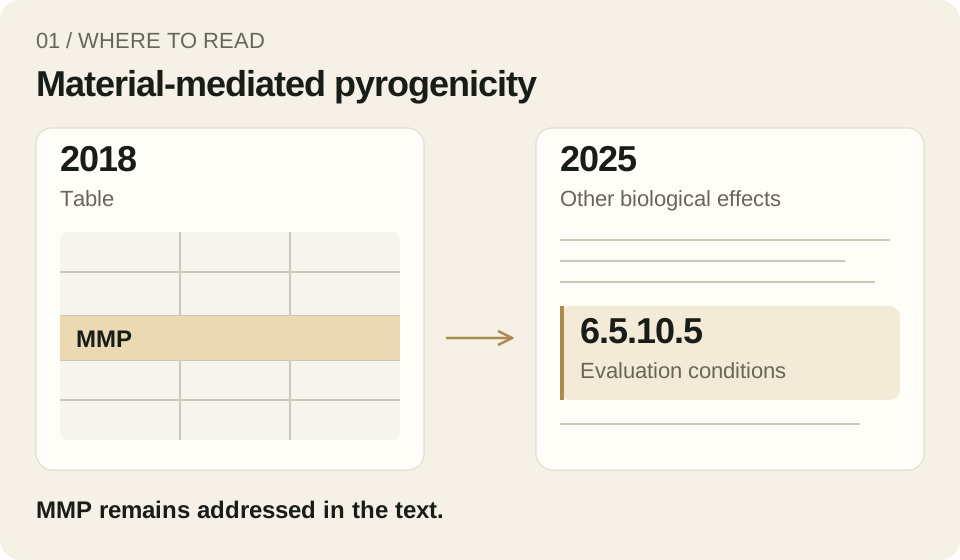
Conceptual connection from MMP in the 2018 evaluation table to clause 6.5.10.5 in the 2025 text
This diagram connects the 2018 table with the 2025 text.
MMP means material-mediated pyrogenicity; clause 6.5.10.5 addresses its evaluation conditions.
It does not reproduce the standard's actual table or paragraphs.

Evaluation conditions in 6.5.10.5

The clause publicly quoted by FDA calls for evaluation when a device contains constituents that have previously caused a pyrogenic response, or chemical constituents with unknown pyrogenic potential.
New materials are given as an example of the latter.
The label “new material” alone does not determine a test method for every situation.
[1, slide 21]

The same clause also describes circumstances in which a justification can often be sufficient.
This encompasses an explanation that the finished device composition, including processing aids and manufacturing contaminants, does not present a significant biological risk from MMP, together with adequate controls to prevent pyrogenic contamination during manufacture.
[1, slide 21]

These points should be read together.
Treating “a justification can be sufficient” as a blanket reason to omit testing, or interpreting “evaluate” as a requirement to perform a particular animal test, changes the scope of the judgment.
An evaluation plan can clearly connect the risk under review, available evidence and remaining uncertainty, then use those findings to determine whether additional testing is needed.

Distinguish MMP from microbial pyrogens

MMP concerns the potential for fever caused by chemicals that may be released from a device during use.
FDA includes manufacturing residues in its explanation.
The causal scope differs from microbial pyrogens such as bacterial endotoxins.
The publicly quoted note to 6.5.10.5 states that assessment of bacterial endotoxins and other microbial pyrogens is outside this document's scope and is addressed in ISO 11737-3.
[1, slides 19 and 21]

Consequently, saying that “pyrogenicity data are available” does not identify which question those data answer.
First distinguish an evaluation of material constituents from results addressing microbial pyrogens.
State the evaluation target and method so that a result for one category is not extended to the whole of another.
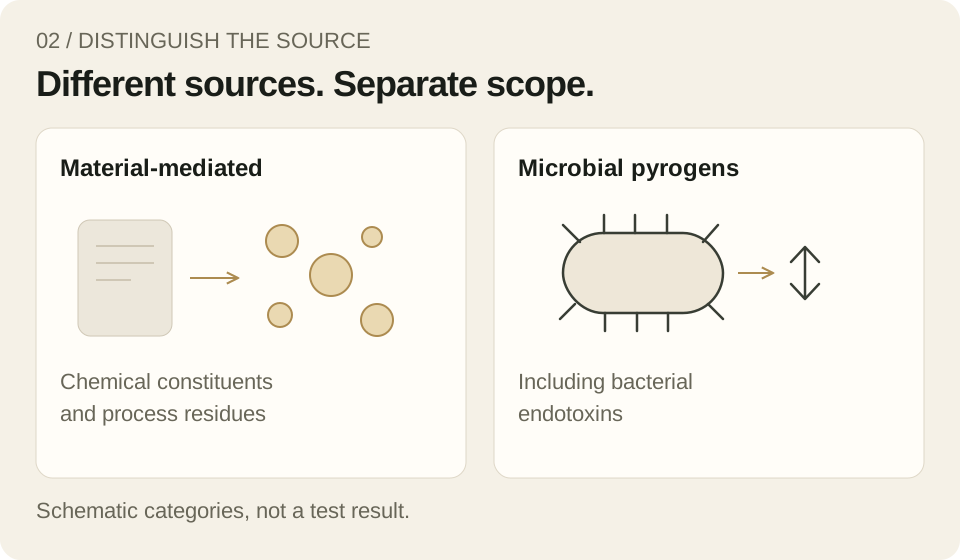
Separate conceptual domains for chemicals released from materials and microbial pyrogens
The left represents chemical causes, including material constituents and process residues.
The right represents microbial causes, including bacterial endotoxins.
The symbols distinguish scope and are not actual molecular structures or test results.

Hypothetical case: missing information about a new material

Assume that a development team is reviewing a new material R for product P.
Its existing plan includes MMP, but a team member proposes deleting it after not finding it in the revised table.
The available information about R does not yet allow a judgment about pyrogenic potential.
This is a hypothetical MedQraft review example, not an actual product evaluation.

Observed status Conclusion not yet supported Next review
The item is not visible in the revised table The evaluation itself has been removed Connect the item to the conditions in 6.5.10.5
Information on R's pyrogenic potential is unconfirmed There is no pyrogenic potential Identify material evidence and uncertainty
Only material introduction information is available The finished device composition is adequately explained Check the scope, including processing aids and manufacturing contaminants
Evidence review is ongoing The need for additional testing is settled Assess the adequacy of the justification and remaining evaluation needs

At this stage, the conclusion is neither that R is unsuitable nor that a particular test must be ordered immediately.
Retain the status that there is not yet a basis for deleting the evaluation, and narrow down the missing information.
When discussing the issue with a laboratory, provide product and material information, available evidence and the conditions that remain unexplained, rather than asking only whether omission is permitted because the item disappeared from the table.

Record the judgment and its rationale in the plan

The following is an in-house practical suggestion, not a mandatory form prescribed by the standard.
Record the applicable edition and clause, the scope of evidence reviewed, remaining questions and the next judgment in the relevant part of the evaluation plan.
As evidence becomes available, show how the initial information gap was resolved.
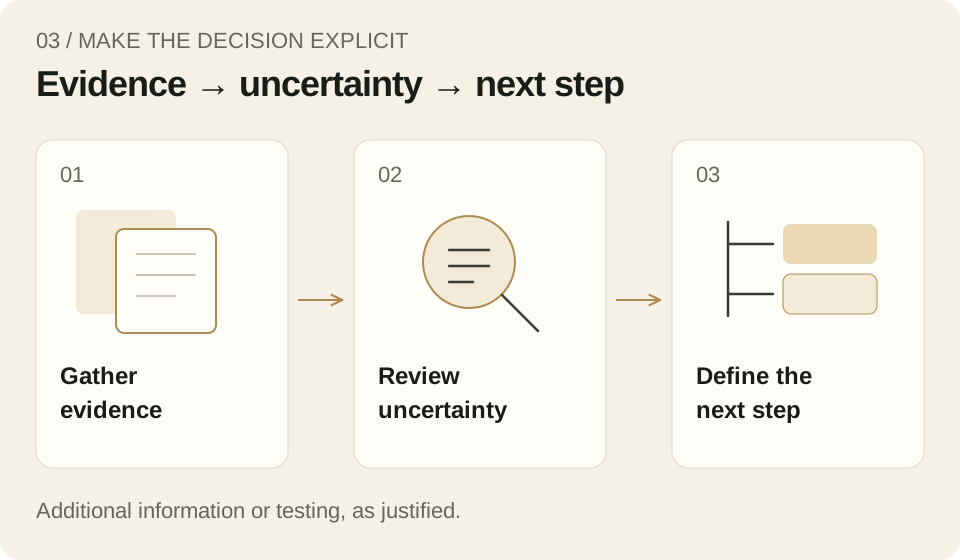
Three steps: gather evidence, review uncertainty and decide the next evaluation approach
This in-house workflow gathers evidence, reviews remaining uncertainty and determines the next evaluation approach, such as additional information or testing.
The two boxes at the final step represent options for review, not an automatic testing exemption.

Three questions remain at the end of the review: What evidence addresses MMP? Does the explanation cover the finished device and manufacturing controls? Can the reason for needing additional information or testing be specified? Absence from the table does not answer these questions.

Scope and sources

Sources were checked on October 19, 2026.
This article was prepared from ISO's official publication information and the revision explanations and clause excerpts publicly available in FDA's official educational material.
It is not a commentary based on reading the entire ISO standard.
Product-specific conformity judgments require lawful access to the applicable edition and product-specific evidence.

FDA's discussion of US evaluation and recognition is not presented as a Korean authorization requirement.
Publication of an international standard and its application or recognition in a sales jurisdiction must be checked separately.
This article establishes neither a general exemption criterion nor a sample size.

  1. FDA, Biocompatibility Town Hall #1, official slides.
    September 9, 2026, slides 9, 19 and 21.
    Original tables and figures have not been reproduced.
  2. ISO 10993-1:2025, official publication information.
    Sixth edition, November 2025.
  3. FDA, official transcript of the same event.
    Used to cross-check the revision and MMP explanation.

Let's talk

Apply what you have read
to your product.

Tell us your product's current stage and the questions you need to review.

Discuss your questions ↗
MedQraft / Let's talk

Project inquiry

Start with your challenge.
We will work through it together.

Tell us your product's current stage and the support you need.
We will review the questions and define a suitable scope of support.

Contact@medqraft.co.kr ↗
Information: name, company, email, inquiry and service of interest · Purpose: responding to your inquiry · Retention: until the inquiry is resolved Read the privacy policy
Privacy policy

MedQraft / Privacy

Privacy policy

MedQraft processes only the information needed for website inquiries.
We delete the collected inquiry information when the inquiry is resolved.

Effective date: September 18, 2026

1. Scope and purposes of processing

This policy applies to visits and business inquiries at www.medqraft.co.kr.
We process personal information to review and respond to inquiries, discuss the scope of support, and operate the website reliably.
Customer business data stored in Q-Atelier is governed by the relevant service agreement and separate notices.

2. Information collected and retention

Required information
Name, email address and inquiry
Optional information
Company, selected service of interest, and contact or business details you provide in your inquiry
Collection methods
Website inquiry forms and email inquiries
Basis for processing
Consent to collection and use provided through the inquiry form.
Where necessary to fulfill a request relating to the formation or performance of a contract, we process information on the applicable legal basis.
Retention period
We retain inquiry information until the inquiry is resolved, then delete it without delay.
If information becomes part of a separate contract, we separately explain the required information and retention period.
Where retention is legally required, only the relevant information is stored separately.

You may decline to provide required information, but this will prevent submission of the website inquiry form.
You can make an inquiry without providing optional information.
Do not submit sensitive information unnecessary for the inquiry, such as national identification numbers or patient information.

3. Service providers and external services

Inquiries are forwarded from the website server through an email delivery service to our company mailbox.
We do not maintain a separate inquiry database in this processing workflow.

Vercel Inc.
Website hosting, server-side inquiry processing, operations and security.
Technical information such as IP address, request time, browser and request details may be processed.
Plus Five Five, Inc. (Resend)
Delivery of inquiry notification emails containing name, email, company, service of interest and inquiry details, and management of delivery logs
Gabia Hiworks
Receipt, storage and replies to inquiries in our company mailbox

We do not sell inquiry information or provide it for advertising purposes.
We do not disclose it for an independent third party's purposes unless there is a lawful basis, such as a legal requirement or separate consent.

4. Overseas processing and storage

Overseas cloud services are used to process website requests and deliver emails.
Information entered in an inquiry is transmitted over an encrypted connection upon submission.

Vercel Inc. / United States
Information is transmitted for inquiry request processing and hosting.
Privacy contact: privacy@vercel.com.
Operational records are subject to the retention periods of the services and settings used and Vercel's processing policies.
Vercel data processing information
Plus Five Five, Inc. (Resend) / United States
Information is transmitted upon submission to deliver the inquiry email and manage delivery records.
Privacy contact: privacy@resend.com.
Resend's published default retention period for emails and logs on its standard plans is 30 days.
Earlier deletion may be requested from the provider.
Resend retention and deletion information

Deleting inquiry emails from our mailbox and deleting technical records held by external providers involve different processes.
You may contact the person listed below about deletion, restriction of processing or overseas processing.
If you do not wish to use overseas processing through the website form, you may email us directly.
The processing policies of the email services used will still apply.

5. Deletion and safeguards

After confirming that an inquiry has been resolved, we delete the email and separately saved copies.
Printed materials, if any, are destroyed by shredding or another method that prevents reuse.
Where deletion of information held by an external processor is necessary, we submit a request through that provider's deletion procedure.

Access to personal information is restricted to staff who need it for their work.
We protect information through HTTPS transmission and account access controls.
We do not publish materials containing personal information in public repositories or on public pages.

6. Your rights

You may request access, correction, deletion, restriction of processing or withdrawal of consent by contacting the designated email address.
We will verify your identity to the extent necessary, process the request under applicable law, and notify you of the result.
If we cannot fulfill a request, for example because of a legal retention obligation, we will explain the reason.
For requests made through a representative, we may verify their authority.

7. Access information and external content

We use Naver conversion tracking to measure visits and completed inquiries attributable to Naver search advertising.
Technical information such as the visited URL, referring page, browser and cookies, and whether an inquiry was completed, may be processed.
The name, email, company and inquiry text entered in the form are not included in conversion events.
You can block or delete cookies in your browser.

Server access information may be processed for website delivery and security.
Vercel Web Analytics is used for anonymous visitor statistics on the introduction page and Insights.
Insights statistics aggregate article views, referral sources, countries and device types.
Visitor analytics do not use analytics cookies.
Names, emails, companies and inquiry text from the consultation form are not included in analytics events.
Instagram-specific links use UTM parameters to identify referral sources.
Loading external video or fonts on the website may transmit technical information, including IP address and browser details, to the relevant provider.

You can block or delete cookies and site data in your browser settings.
Some features or external content may be restricted depending on your settings.

8. Privacy officer and contact

Business
MedQraft / Representative: Byeonghwi Kim
Privacy officer and inquiry contact
Byeonghwi Kim
Email
Contact@medqraft.co.kr
Postal inquiries
Suite 222, 56 Geumto-ro 80beon-gil, Sujeong-gu, Seongnam-si, Gyeonggi-do, Republic of Korea (Geumto-dong, Widen Tower)

For privacy-related complaints, you may contact the Personal Information Infringement Report Center or the Personal Information Dispute Mediation Committee for assistance.

9. Changes to this policy

Changes to processing purposes, information collected, retention periods or service providers will be published on this page with their effective date.

September 18, 2026: Website inquiry privacy policy first published

October 14, 2026: Added information on Insights visitor analytics and Instagram referral measurement