
Medical Device EMC: Planning Separately for Emissions and Immunity
This article explains the process of distinguishing between the electromagnetic emissions from devices and their responses to external interference, as well as translating functionality-specific observation items into a test plan.
Emissions and Immunity are Evaluated Differently
Electromagnetic compatibility (EMC) of medical devices addresses the relationship between devices and the surrounding electromagnetic environment.
Emissions refer to the electromagnetic waves leaving the device, while immunity evaluates whether the device maintains its intended operation under external electromagnetic disturbances.
Thus, the two tests differ in the observations and the manner of interpreting the results.
When discussing test plans, distinguishing these directions first helps avoid confusion between the electromagnetic waves to be measured and the device functions to be observed.
This reduces errors such as interpreting emission test measurements as function observation records for immunity tests or explaining the entire operation of a device solely based on whether the screen is on.
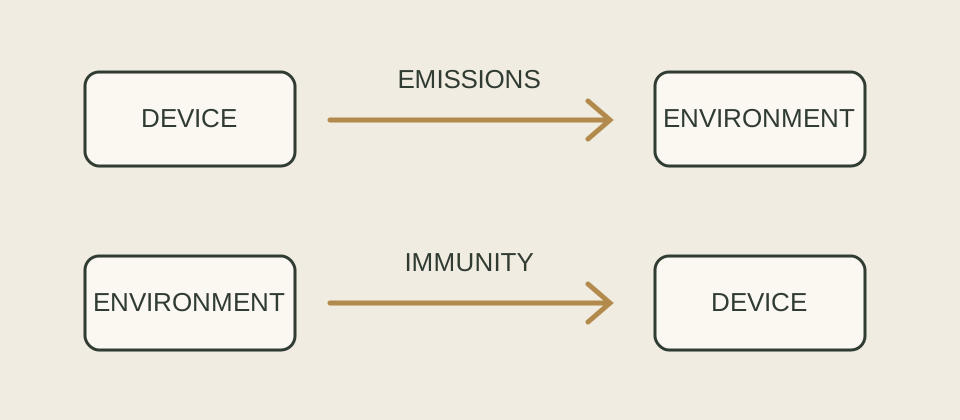
Figure 1.
The upper section illustrates the effects exerted by the device on the external environment, while the lower section represents the device's response to external disturbances.
This is not a depiction of an actual test setup or propagation path.
Define the Scope and Clarify Test Conditions
This article aims to help understand the EMC testing of medical devices using electrical and electronic circuits.
The FDA's final guidance in 2022 targets medical devices and associated components with electrical functions or sensors.
This is non-binding advice regarding U.S. submission materials and does not replace legal requirements for domestic approval.
The market, use, environment, and applicable standards for each product must first be defined to determine the level and structure of testing.
No specific electric field strengths, frequency ranges, distances, or common pass criteria are provided here.
In actual test plans, the latest requirements applicable to the specific product should be reviewed with the testing institution.
Virtual Case: Device M with Screen and Output
For explanation purposes, let's assume a development device M that takes sensor input, displays values on a screen, and outputs through an external interface.
This is a hypothetical case and not a representation of any actual product or test results.
Initially, the development team noted "check if screen is normal" while discussing the observation items for the immunity test.
This statement has a narrow scope of observation and the meaning of normal is unclear.
Although the screen may continuously update, the output data can stop, and while the output is maintained, outdated values may remain on the screen.
In this case, it's better to review the screen, output, and status display separately to clarify the basis for assessment.
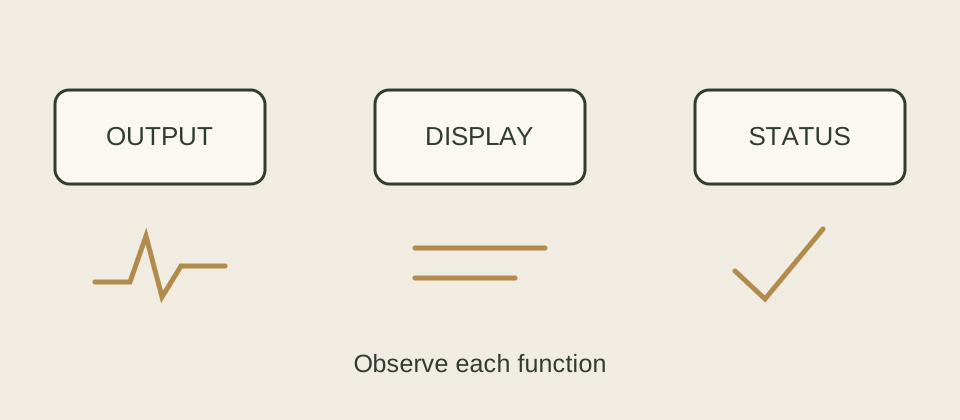
Figure 2.
An example dividing the observation items of the virtual device M into output, screen, and status display.
This does not imply that all medical devices share these three common functional requirements.
| Features of Virtual Device M | Content to Specify in the Plan | Observational Basis to Leave Together |
|---|---|---|
| External Output | Expected output, allowable deviation, methods for judgments on omissions | Data correlating input conditions and output records |
| Screen Display | Means to distinguish changes and updates in displayed values | Screen records or observation sheets with timestamps |
| Status Display | How to indicate any state when a change in functionality occurs | Order of status transitions vs. occurrence of functional changes |
This table is an example of a test plan organization from MedQraft.
Actual allowable deviations and timing criteria must be determined based on the product's functional requirements and risk assessment results.
Items not filled with numerical values are not subjects for arbitrary pass criteria to be attached after the test; instead, they are points for establishing a basis during the planning stage.
Immunity Testing Must Connect Functions and Criteria
The FDA recommends that the criteria for immunity determination be established before testing, enabling specific and quantitative observations of the device and its functions.
It also describes the test configuration and operating modes.
Essential performance should be driven by risk and does not represent all functions.
Even devices judged not to have essential performance require suitable immunity criteria.
In the plan for virtual device M, observation methods can be attached next to the function names.
For example, instead of simply stating "maintain output," describe what inputs will be given and what outputs will be recorded.
If screen records and output logs cannot be correlated with each other, it becomes challenging to compare the same events across two records.
In such cases, planning how to correlate the timestamps or event markers is also beneficial to include.
The observation method itself may influence the test configuration; hence, it is advisable to discuss configurations with the testing institution when connecting separate cables or recording devices.
The conceptual images in this text are not procedural documents directing wiring or measurement placements.
Distinguish Between During and After Disturbance
Assume that after the test of the virtual device M, only one record remains depicting the screen state at the test's completion.
While that photo may reveal the state at the end, it cannot indicate whether the output was interrupted during previous intervals.
Observation records must cover the time intervals where the phenomena to be judged occur.
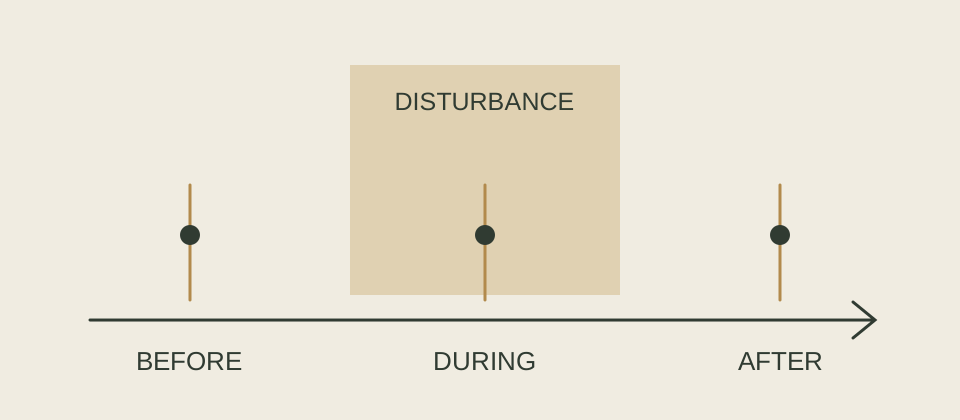
Figure 3.
A conceptual diagram to organize the time ranges of observation records.
The number of points does not represent actual sampling counts or cycles, nor does it propose allowable performance changes or recovery times.
During the planning review, specifying separate notes for "when to observe" and "what changes are permissible" can be helpful.
This is to avoid treating the fact that recovery occurred post-termination and that the required performance was maintained during disturbances as the same.
Specific observation intervals and recovery allowances should be determined according to the applied tests and the product's risk.
A One-Page Table to Organize Before Requesting Tests
In practice, the following items can correspond between the test request form and internal review records.
The format itself is not a mandatory format specified by regulatory agencies.
| Division | Content to Record | Review Questions |
|---|---|---|
| Test Direction | Emission or Immunity | Are you measuring electromagnetic waves emitted externally, or observing device responses? |
| Product Configuration | Model, Version, Accessories, Cables, Operational Modes | Which actual use configuration does it represent? |
| Functional Observation | Observation Functions, Methods, Time Intervals | Can the changes of functionalities be determined by results alone? |
| Basis for Judgment | Criteria and Reasons for Setting Them | Are the allowable deviations or ranges of change linked to product requirements? |
If the development team for device M finds the phrase "normal operation" in the current plan, they can first break this down into observable functions and recording methods.
This process will expose any empty items as specific agenda for collaboration between design and testing personnel.
Sources and Related Articles
Date of Confirmation: October 6, 2026.
This explanation differentiated technical concepts from FDA recommendations and did not replicate illustrations or tables from the original text.
The three figures and the example for device M, as well as the practical organization table, were created independently.
- FDA, Electromagnetic Compatibility (EMC).
Concepts of EMC and electromagnetic environments explained. - FDA, Electromagnetic Compatibility (EMC) of Medical Devices, Final Guidance, June 6, 2022.
Official PDF, II Scope, IV.D Immunity Criteria, IV.E Test Configuration and Function Reference.
Related Article: Connecting Evidence in Medical Device Risk Management.
This article explains the perspective of connecting risk analysis and test evidence.
Let's talk
Apply what you have read
to your product.
Tell us your product's current stage and the questions you need to review.
Discuss your questions ↗