
MedQraft
← All insights
Human tissues & biomaterials

Particle Size Analyzers and Rheometers: Two Tools for R&D in Bio-Material Medical Devices

This article organizes the principles and reading methods of particle size analyzers (D10·D50·D90) and rheometers (G'·G'') from the perspective of developing bio-material medical devices such as hemostatic agents, bone grafts, and hydrogels.

Last regulatory review: 2026-07-22 Rev. 1.0 6 min read

While conducting medical device research and development, you may hear these phrases:

  • "Let's do a particle size analysis on this."
  • "What is the G' value for this gel?"

At first, terms like D10·D50·D90 and G' and G'' might sound unfamiliar.
However, as you develop bio-material-based medical devices like hemostatic agents, bone grafts, medical device fillers, and hydrogels, you will realize that these numbers are not just exam results.
The particle size affects the handleability and manufacturing process of the product, while the viscoelasticity of the gel relates to injectability and shape retention.

In this article, we will summarize the basic principles and reading methods of the two devices frequently encountered in R&D: particle size analyzers and rheometers.
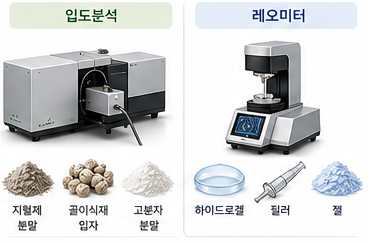
Particle Size Analyzer and Rheometer Equipment, and Their Related Materials: Hemostatic Agents, Bone Grafts, Polymer Powders, Hydrogels, Fillers, and Gels

Particle Size Analyzer: "How big are these powder particles?"

In powder-based hemostatic agents or particle-type bone grafts, the size and distribution of particles are critical data for understanding product characteristics.
For powder-based hemostatic agents, particle size and distribution can affect handleability and spreadability; for bone grafts, it can impact filling characteristics and methods of use.

Even when using the same raw material, differing particle size distributions can change product characteristics and manufacturing processes.
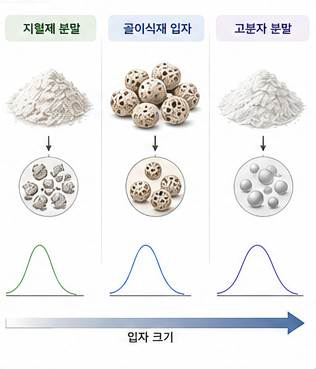
Comparison of Particle Shapes and Size Distributions for Hemostatic Agent Powders, Bone Graft Particles, and Polymer Powders

Practical Tip

Thus, particle size analysis is more about confirming "Are the particle characteristics of our product being managed consistently?" rather than simply determining "What is the particle size of this raw material in μm?"

Principle of Laser Diffraction Method

The most common principle of particle size analyzers is the laser diffraction method.
When a laser is directed at particles, light is scattered; larger particles tend to scatter at a narrow angle, while smaller particles scatter at a wider angle.
The equipment analyzes this scattering pattern to calculate the particle size distribution.
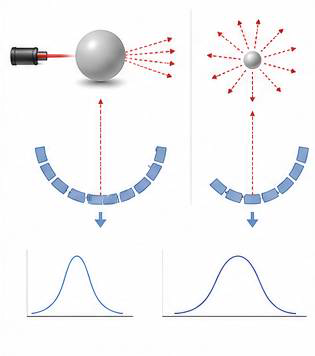
Laser Diffraction Principle: Big particles scatter light at a narrow angle, small particles at a wide angle, and this pattern calculates size distribution

Caution

The size measured by the laser diffraction method is not strictly the same concept as the diameter measured directly through a microscope.
Results may vary depending on particle shape and optical models.
The key issue is not simply stating "measured by laser diffraction method" but rather "Is this method appropriate for evaluating the particle characteristics of our product?"

Surprisingly Important: Sample Preparation

Problems frequently arise not from the equipment but rather from the sample preparation process in particle size analysis.
In wet analysis, samples are dispersed in a liquid; protein materials like gelatin or certain natural polymers may swell or dissolve when in contact with water.

If you carelessly disperse the material in water, you risk obtaining particles in a state that has been altered by water rather than the original powder.
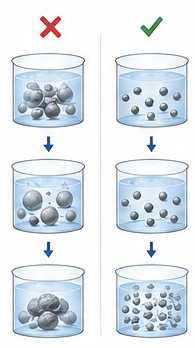
Sample Dispersion States: Clumping or swelling (✗) vs evenly dispersed (✓)

Thus, when determining the testing method, consider the following:

  • What dispersion medium will be used?
  • Is the sample concentration appropriate?
  • Is the dispersion time sufficient?
  • Is stirring or ultrasonic treatment necessary?
  • Is there a risk of swelling or dissolving the sample?
  • Is there any agglomeration occurring during measurement?

Reading D10·D50·D90

Particle size analysis results yield three numbers:

  • D10: 10% point of the particle size distribution
  • D50: 50% point (commonly viewed as the representative diameter)
  • D90: 90% point

While D50 is often regarded as the representative value, it alone does not sufficiently describe the distribution.
Two samples could have the same D50, but one might have uniformly sized particles while the other has a wide mixture of small and large particles.
Here, looking at D10 and D90 together reveals the difference between the two samples.
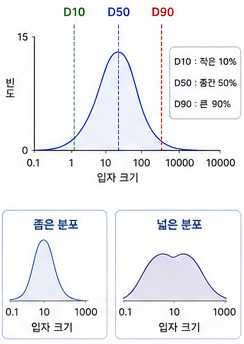
Meaning of D10·D50·D90, and the difference between narrow and wide distributions despite having the same D50

Rheometer: "How hard is this gel?"

When developing hydrogels or medical device fillers, you will encounter a rheometer.
Such products cannot simply be described visually as gel-like.
It's essential to know how easily they deform, how well they recover when force is removed, whether they have flow properties, and if they retain shape.

A rheometer is a device for evaluating this viscoelasticity.
For example, jelly can return to its original shape to some extent when pressed and released, while water flows when a force is applied.
Hydrogels possess both properties to some degree.
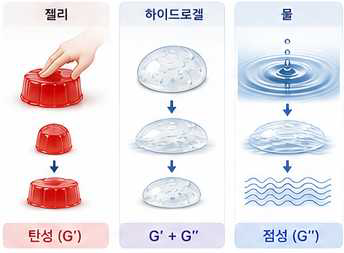
Viscoelastic Spectrum from Jelly (elastic G') to Hydrogel (G'+G'') to Water (viscous G'')

G' and G''

  • G' (Storage Modulus): Represents elastic properties.
    A larger G' signifies a stronger tendency to return to original shape.
  • G'' (Loss Modulus): Represents viscous properties.
    A larger G'' indicates a stronger tendency to flow.

Generally, if G' > G'' it is interpreted that elasticity predominates, while G'' > G' indicates that viscosity is predominant.
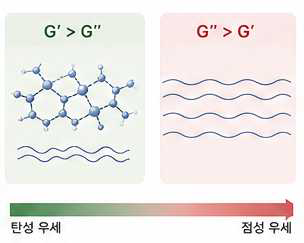
If G' is greater than G'', elasticity predominates; if G'' is greater than G', viscosity predominates

Caution

Stating "G' is 100 Pa" is far less accurate than stating "G' measured under specific conditions is 100 Pa."
This is because results can vary based on measurement temperature, frequency, strain, and sample preparation methods.

Is a higher G' always better for fillers?

Not necessarily.
Fillers and hydrogels require different properties depending on their intended use.
For products where shape retention is critical, elasticity is important; however, for products where injectability is key, too high a modulus may actually hinder usability.
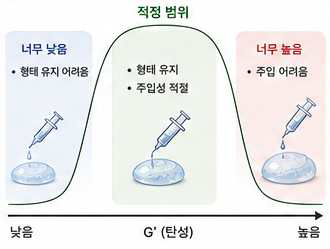
Optimal Range for Filler G' (Elasticity): Too low impedes shape retention, too high makes injection difficult

The core issue is not simply whether "G' is high," but rather whether it has properties suitable for the product's intended use.

Key Points to Remember

  • Particle Size Analysis: Do not look solely at D50; consider D10 and D90 as well.
  • Rheometer: Look at G' and G'' numbers, but also consider measurement conditions.
  • For both tests, "How was the measurement conducted?" is just as important as "What results were obtained?"

In the next article, we will take a step further.
"What is necessary for using these analytical results as regulatory documentation?" We will examine analysis method validation, repeat testing, the significance of n=3, inter-batch variation, and comparisons before and after sterilization from a regulatory perspective.

Frequently asked questions

How many times should particle size analysis be repeated?

There is no single official number that applies to every test.
Repeating a measurement on the same sample, testing independently collected samples, and comparing batches involve different types of repetition.
Design the study around the test objective and product characteristics.

Let's talk

Apply what you have read
to your product.

Tell us your product's current stage and the questions you need to review.

Discuss your questions ↗
MedQraft / Let's talk

Project inquiry

Start with your challenge.
We will work through it together.

Tell us your product's current stage and the support you need.
We will review the questions and define a suitable scope of support.

Contact@medqraft.co.kr ↗
Information: name, company, email, inquiry and service of interest · Purpose: responding to your inquiry · Retention: until the inquiry is resolved Read the privacy policy
Privacy policy

MedQraft / Privacy

Privacy policy

MedQraft processes only the information needed for website inquiries.
We delete the collected inquiry information when the inquiry is resolved.

Effective date: September 18, 2026

1. Scope and purposes of processing

This policy applies to visits and business inquiries at www.medqraft.co.kr.
We process personal information to review and respond to inquiries, discuss the scope of support, and operate the website reliably.
Customer business data stored in Q-Atelier is governed by the relevant service agreement and separate notices.

2. Information collected and retention

Required information
Name, email address and inquiry
Optional information
Company, selected service of interest, and contact or business details you provide in your inquiry
Collection methods
Website inquiry forms and email inquiries
Basis for processing
Consent to collection and use provided through the inquiry form.
Where necessary to fulfill a request relating to the formation or performance of a contract, we process information on the applicable legal basis.
Retention period
We retain inquiry information until the inquiry is resolved, then delete it without delay.
If information becomes part of a separate contract, we separately explain the required information and retention period.
Where retention is legally required, only the relevant information is stored separately.

You may decline to provide required information, but this will prevent submission of the website inquiry form.
You can make an inquiry without providing optional information.
Do not submit sensitive information unnecessary for the inquiry, such as national identification numbers or patient information.

3. Service providers and external services

Inquiries are forwarded from the website server through an email delivery service to our company mailbox.
We do not maintain a separate inquiry database in this processing workflow.

Vercel Inc.
Website hosting, server-side inquiry processing, operations and security.
Technical information such as IP address, request time, browser and request details may be processed.
Plus Five Five, Inc. (Resend)
Delivery of inquiry notification emails containing name, email, company, service of interest and inquiry details, and management of delivery logs
Gabia Hiworks
Receipt, storage and replies to inquiries in our company mailbox

We do not sell inquiry information or provide it for advertising purposes.
We do not disclose it for an independent third party's purposes unless there is a lawful basis, such as a legal requirement or separate consent.

4. Overseas processing and storage

Overseas cloud services are used to process website requests and deliver emails.
Information entered in an inquiry is transmitted over an encrypted connection upon submission.

Vercel Inc. / United States
Information is transmitted for inquiry request processing and hosting.
Privacy contact: privacy@vercel.com.
Operational records are subject to the retention periods of the services and settings used and Vercel's processing policies.
Vercel data processing information
Plus Five Five, Inc. (Resend) / United States
Information is transmitted upon submission to deliver the inquiry email and manage delivery records.
Privacy contact: privacy@resend.com.
Resend's published default retention period for emails and logs on its standard plans is 30 days.
Earlier deletion may be requested from the provider.
Resend retention and deletion information

Deleting inquiry emails from our mailbox and deleting technical records held by external providers involve different processes.
You may contact the person listed below about deletion, restriction of processing or overseas processing.
If you do not wish to use overseas processing through the website form, you may email us directly.
The processing policies of the email services used will still apply.

5. Deletion and safeguards

After confirming that an inquiry has been resolved, we delete the email and separately saved copies.
Printed materials, if any, are destroyed by shredding or another method that prevents reuse.
Where deletion of information held by an external processor is necessary, we submit a request through that provider's deletion procedure.

Access to personal information is restricted to staff who need it for their work.
We protect information through HTTPS transmission and account access controls.
We do not publish materials containing personal information in public repositories or on public pages.

6. Your rights

You may request access, correction, deletion, restriction of processing or withdrawal of consent by contacting the designated email address.
We will verify your identity to the extent necessary, process the request under applicable law, and notify you of the result.
If we cannot fulfill a request, for example because of a legal retention obligation, we will explain the reason.
For requests made through a representative, we may verify their authority.

7. Access information and external content

We use Naver conversion tracking to measure visits and completed inquiries attributable to Naver search advertising.
Technical information such as the visited URL, referring page, browser and cookies, and whether an inquiry was completed, may be processed.
The name, email, company and inquiry text entered in the form are not included in conversion events.
You can block or delete cookies in your browser.

Server access information may be processed for website delivery and security.
Vercel Web Analytics is used for anonymous visitor statistics on the introduction page and Insights.
Insights statistics aggregate article views, referral sources, countries and device types.
Visitor analytics do not use analytics cookies.
Names, emails, companies and inquiry text from the consultation form are not included in analytics events.
Instagram-specific links use UTM parameters to identify referral sources.
Loading external video or fonts on the website may transmit technical information, including IP address and browser details, to the relevant provider.

You can block or delete cookies and site data in your browser settings.
Some features or external content may be restricted depending on your settings.

8. Privacy officer and contact

Business
MedQraft / Representative: Byeonghwi Kim
Privacy officer and inquiry contact
Byeonghwi Kim
Email
Contact@medqraft.co.kr
Postal inquiries
Suite 222, 56 Geumto-ro 80beon-gil, Sujeong-gu, Seongnam-si, Gyeonggi-do, Republic of Korea (Geumto-dong, Widen Tower)

For privacy-related complaints, you may contact the Personal Information Infringement Report Center or the Personal Information Dispute Mediation Committee for assistance.

9. Changes to this policy

Changes to processing purposes, information collected, retention periods or service providers will be published on this page with their effective date.

September 18, 2026: Website inquiry privacy policy first published

October 14, 2026: Added information on Insights visitor analytics and Instagram referral measurement