
If Battery Level Is Displayed, Is Power Interruption Risk Managed?
In the power review of home and portable medical devices, we distinguish between battery level display, operation duration, and the distinction between interruption and restart.
We explain the development team's review questions and data connection methods using a hypothetical measuring device case.
1. Questions That Battery Level Display Does Not Answer
In a development meeting, we check the screen of a portable measuring device.
A battery icon is displayed, and when the charger is connected, it changes to a charging state.
The responsible person reports that the display function is implemented.
Up to this point, it is a clear fact.
However, it is not clarified whether we can complete the scheduled measurements solely based on this fact, and whether the results can be misunderstood if the power cuts out.
The existence of the battery level display, securing the necessary operating time, and the operation during power interruption are different review subjects.
Bundling these three questions may easily lead to the interpretation that passing the display test answers the other questions.
This document serves as a practical explanation for developers and quality personnel in home and portable medical devices when preparing power-related reviews.
The ‘Portable Measuring Device P’ below and the meeting notes are a hypothetical case created by MedQraft.
It is not an evaluation of the performance or clinical safety of actual products nor is it a patient's device operation guide.
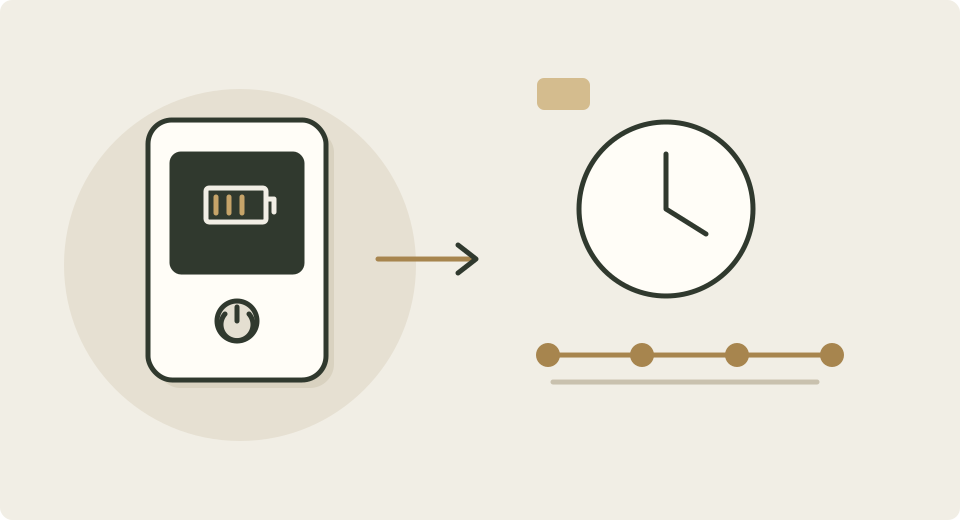
Battery level display provides information about the current state, while operation duration is a performance that should be checked along with usage conditions.
2. Official Recommendations and Scope of This Document
The FDA’s design guidance for home-use devices discusses operation time, power life, use during charging, and prior notifications for devices that rely on internal power.
It also reviews backup power and guidance information regarding AC power interruptions.
This document references the aforementioned guidance as a starting point for power reviews.
FDA Original Document, VII.E.2 and VII.E.5
This is a non-binding design guideline in the United States.
It does not transfer past regulatory provisions and specification numbers included in the 2014 issuance and 2016 partial revision document to current requirements.
Submission materials or test specifications for specific markets should be separately verified for current applicability by product.
The following status distinctions, comparison tables, and review notes are MedQraft's internal practical suggestions.
They do not reproduce mandatory forms from the guidance.
Since the consequences of interruptions differ between devices that need continuous treatment and those that perform one-time measurements, a uniform application of power response cannot be applied.
3. Dividing Hypothetical Measuring Device P Questions into Three Categories
Measuring Device P is a hypothetical device used by users to start measurements and save results.
The development team only has a record of ‘battery icon display confirmation complete’.
Reviewers do not need to deny this.
Instead, they should define the scope answered by this record and separate the remaining questions.
| Review Target | Questions to Confirm in Meeting | Example of Related Data |
|---|---|---|
| Status Indication | What status does it indicate through which symbol or phrase? Is there a possibility for users to misunderstand the unupdated display as the current state? | Display specifications, state transition records, screen review results |
| Operation Duration | Under what conditions can the planned usage sequence be completed? What conditions does the operation time in the instructions assume? | Usage scenarios, power test conditions, actual observation records |
| Interruption and Recovery | How are ongoing measurements and records processed? Can completion be distinguished after a restart? | Definition of operation during interruptions, result storage rules, recovery test records |
The purpose of this table is not to gather a lot of data.
Instead, it aims to narrow down the meaning of ‘confirmation complete’.
For instance, a screenshot may show the display at a specific point in time, but it may not represent whether the display appropriately changed throughout the entire measurement process.
4. Viewing Before, During, and After Interruption
For power reviews, MedQraft proposes a method of dividing questions chronologically.
This does not imply that all products should be stopped in the same manner, but rather suggests that we first define how products should operate at each stage.
Before Interruption: What situations need to be communicated, and what should a notified user do?
We examine whether the low battery warning is connected to necessary actions.
We do not assume that the mere existence of a notification means the user recognizes and understands it.
During Interruption: If the power disappears before the measurement is complete, how do we distinguish ongoing results?
In the case of the hypothetical measuring device P, we can pose review questions about situations where incomplete results could be confused with complete results.
The appropriate method for processing results must be determined according to usage purpose and risk analysis.
After Recovery: When power is restored, in which state does the device start?
We check whether the previous progress state, stored records, and messages shown to the user are consistent.
Regardless of whether automatic recovery or manual restart occurs, the reasons for the choice and expected operations must be explained.
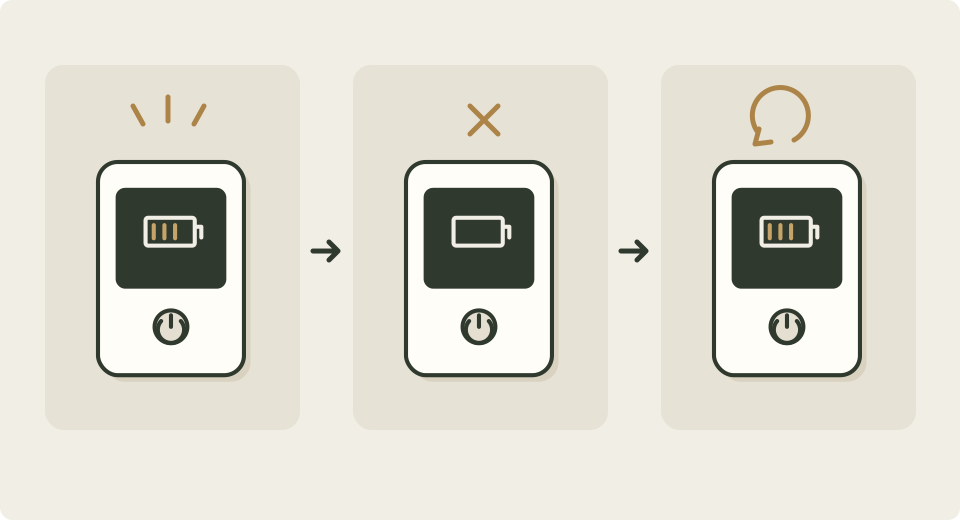
By examining the sequence from notification to interruption state and restart, questions that might be missed when only checking one screen become evident.
5. Clearly Define Test Conditions First
If we create a test plan for the hypothetical measuring device P, it is better to first note the usage scenario to be confirmed than to use the title ‘Battery Test Conducted’.
For example, ‘Power interruption before saving results after measurement starts’ reveals the scene to be reviewed.
The subsequent control of power, as well as which equipment and methods will be used, will be specified by the test personnel considering product structure and safety.
The items below are not a completed test procedure but questions meant to find missing conditions while discussing a test plan.
- Is the model of the test subject, hardware/software versions, and power configuration clear?
- Do the functionalities and sequence performed in the test truly represent the intended usage scenario?
- Have we defined the initial power status and battery history and other conditions necessary for result interpretation?
- Have we distinguished what the current test is confirming among display, operation duration, and record processing?
- Have we set expected results before the test and prepared methods for comparing observed results with them?
- Can we explain which materials to review again after design changes?
The necessary combinations of test scope and conditions vary by product.
This document does not provide arbitrary battery ratios, warning points, or common operation times.
If tests have not yet been performed, it is crucial to distinguish between ‘expected’ and ‘confirmed results’ and record them.
6. Examining Charging Configuration and Actual Usage Environment Together
Power review does not end with just the device body.
The FDA’s charging safety guidance emphasizes adherence to the charging accessories and user instructions provided by manufacturers.
Taking a charger from another device just because it has the right connector is not appropriate.
From the development team's materials perspective, the combinations that have been reviewed, including the main body, battery, charger, and cables, can be documented.
If there are modified accessories, we should revisit whether existing materials explain that combination.
This does not mean that we should repeatedly conduct the same tests every time we change an accessory, but rather a recommendation to avoid omitting the assessment of applicability.
The usage environment is essential as well.
The FDA explains that home lighting and ambient noise might affect device usage and notification perception.
FDA Home Environment Considerations
Therefore, it would be prudent not to conclude that the target user’s perception was confirmed solely based on the developer’s experience of seeing notifications at their office desk.
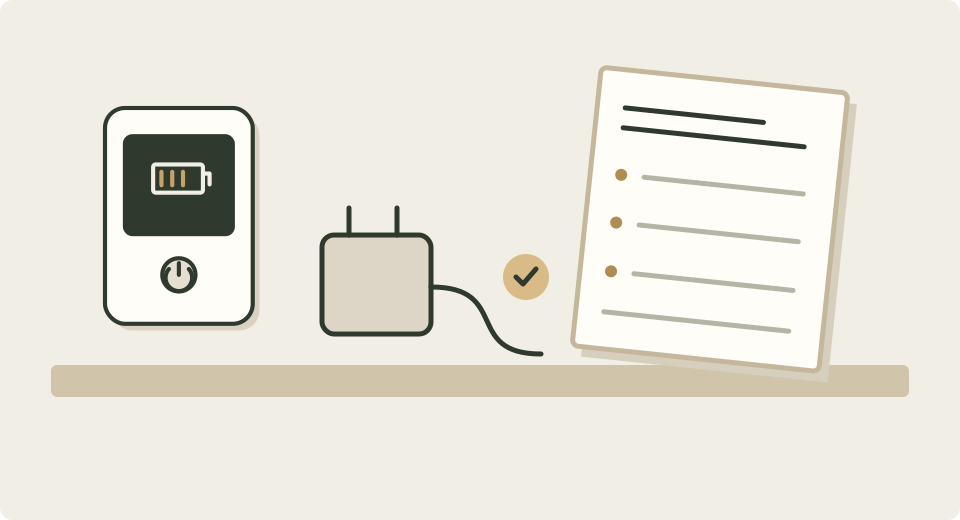
Recording the combinations of the reviewed main body and accessories allows explaining the applicability of existing materials after changes.
7. Transform Meeting Notes into Decisive Statements
The meeting notes for the hypothetical measuring device P can be specified as follows.
‘Unverified’ is not a definitive expression of danger, but rather indicates a state where judgment grounds have yet to be established.
| Short Record with Unclear Scope | Example of Records Revealing Review Scope |
|---|---|
| Battery display normal | Confirmed battery icon display on the designated screen. This confirmation does not include state transition and operation duration. |
| Passed power test | Linked test records to defined conditions and expected results. Conditions not tested remain separately noted. |
| No issues after interruption | Documented interruption point, processing of ongoing results, and state after restart separately. Distinguishing incomplete results requires further review. |
| Compatible charger | Specify the combinations of reviewed main body, battery, and charging accessories. Do not use it as an implied approval for other combinations. |
In meetings, first confirm the facts, then write down interpretations and decisions separately.
The responsible person decides whether the reviewed grounds are sufficient for the product's judgment after reviewing the evidence.
Expressing the actual verification scope accurately takes priority over merely filling in the table.
8. Documentation to Read Along with Today's Checks
Today, pick one product and write the following three sentences:
What does the user need to know about the power status?
What action should the device maintain or terminate during power interruption?
How can we distinguish between completed and incomplete upon recovery?
Each sentence should be linked to the corresponding evidence material and unconfirmed items.
The key is not to draw the battery icon in more detail.
We must be able to explain the state indicated and the actual device operation together.
If that connection is clear, it reduces the possibility of development, quality, and regulatory personnel reading the same material differently.
Further readings:
- What Should Remain After the Risk Management Analysis Table of Medical Devices: A fundamental perspective on connecting risk management grounds.
- Software Testing Passed, Which Requirements Were Confirmed?: Distinguishes between requirements and the scope of testing confirmation.
Official Ground Verification Date: September 30, 2026.
- FDA, Design Considerations for Devices Intended for Home Use, issued on November 24, 2014, partially revised on August 8, 2016.
Applicable guidance has referenced the scope of III and VII.E.2·VII.E.5 and power-related recommendations.
This is a non-binding guidance document in the United States. - FDA, Tips to Help Charge Medical Devices Safely and Avoid Overheating, official public guidance.
It has referenced contents regarding charging accessories. - FDA, Unique Considerations in the Home, official public guidance.
It has referenced contents regarding lighting and ambient noise.
The illustrations and evaluation tables are produced directly by MedQraft.
The examples in this article are intended to assist development reviews and do not present methods for power interruption testing of specific devices or patient response procedures.
Let's talk
Apply what you have read
to your product.
Tell us your product's current stage and the questions you need to review.
Discuss your questions ↗