
Same Model, Different Lots: How to Read UDI in Two Parts
This article explains how to differentiate the DI and PI of the UDI set by the FDA and illustrates with a hypothetical receiving case how to read and record different lots of the same model.
1. We Received Two Boxes of the Same Model
The receiving personnel received two boxes of Model P.
While the model name is the same, one box is from Lot A and the other box is from Lot B.
If only the model name is recorded on the receiving sheet, the stock quantities can be summed, but it will be difficult to determine later which lot is stored where.
This article explains how to read identification information based on the UDI system of the FDA.
The situation above is a hypothetical case created by MedQraft.
This is not a document to determine applicability by country or specifics of labeling obligations for particular products.
2. DI and PI Answer Different Questions
The FDA describes UDI as consisting of Device Identifier (DI) and Production Identifier (PI).
DI is the fixed part that identifies the labeler and specific version or model.
PI is the conditional variable part that may contain production information, such as lot/batch number, serial number, expiration date, and manufacturing date.
Not all products contain the same items in their PI.
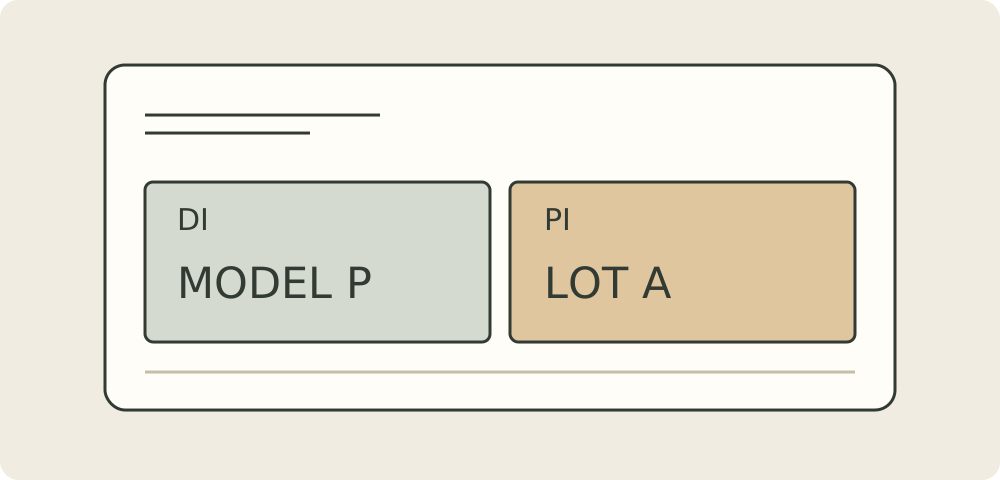
We determine what model it is with the DI and read the production information included in the PI.
| Reading Part | Question Answered | Hypothetical Case Contents |
|---|---|---|
| DI | Which labeler’s version/model is it? | Do both boxes have the same model identification information? |
| PI | What production information is indicated? | This case's Lot A and Lot B |
Thus, it is misleading to understand the DI as a serial number assigned to each individual box.
Conversely, we should not assume that merely storing the lot number will always allow us to ascertain the model.
Maintaining the relationship between both pieces of information in records is key.
3. Same DI but Different Lots
In this case, we assume two boxes comparably from the same labeler’s model and packaging level.
The DIs are the same, but the lot values contained in the PIs are different.
This is practice in reading the fact that they are the same model and the fact that the production batches are different.
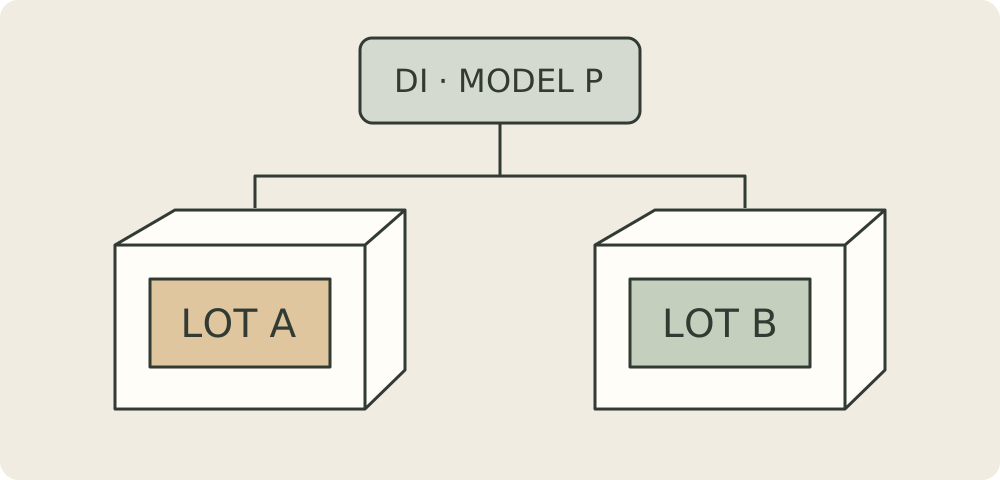
Although the model is the same, we record Lot A and Lot B separately.
| Receiving Line | Model Identification Information | Indicated Lot | Storage Location |
|---|---|---|---|
| 1 | Model P corresponding to the same DI | A | Shelf 1 |
| 2 | Model P corresponding to the same DI | B | Shelf 2 |
The P, A, and B in the table are explanatory symbols and not issued UDIs.
The method of separating the receiving lines and storage locations is also a practical proposal.
Define actual management items according to the traceability requirements of product and company.
When a traceability request regarding Lot A comes in, this table allows us to narrow down the relevant receiving line and storage location immediately.
To check after shipping, we must link that line to the shipping records.
The act of reading UDI and maintaining the movement and shipping history within the organization must be designed as separate tasks.
4. Roles of Public Databases and Receiving Records
The FDA’s GUDID is a reference database for finding device identification information.
The actual PI values are not stored; it provides information on what types of PIs are included in the UDI of that device.
You can search for device information by DI in AccessGUDID.
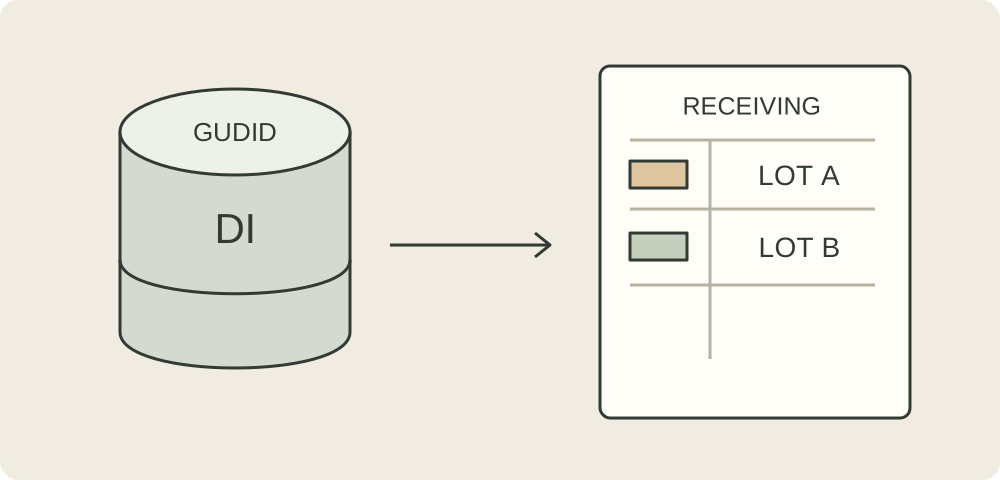
The role of public device information and actual receiving lot records is different.
Practically, consider checking if the model information retrieved by DI corresponds to the received product and that the lot indicated on the packaging is recorded in actual receiving records.
Do not replace the model information retrieved from GUDID with the history of actual received lots.
5. Verification Procedure with One Label
Here are MedQraft’s practical suggestions for data verification.
This is not a legally required record list for specific products.
Identify the subject.
Write down the product name, model, and the packaging unit you are reading.
Avoid mixing different packaging levels for the same subject.Separate the identification information.
Check DI and PI items according to the issuing authority’s system you are using.
Avoid arbitrary cutting of characters from both ends.Compare the read values.
Compare scan results with human-readable labels and check if DI, lot, and date entered as intended.
UDI is typically displayed in both human-readable form and machine-readable identification/data capture form.Link to operational records.
Decide where to maintain necessary production information amid receiving, storage, and shipping records, and try searching again with one sample.
It is advisable not to judge that field separation is accurate based solely on a successful scan notification.
For instance, if the lot comes in attached at the end of a string but the system treats the entire value as a model code, subsequent searches by lot may not operate as expected.
Such issues should be confirmed through tests of reading and searching samples in actual use programs.
6. Interpretation Scope and Check Questions
The application of the U.S. UDI has exceptions and alternative methods, and the actual display format must be confirmed by the issuing authority system used.
This article’s diagrams are not samples of labels from specific issuing authorities.
Do not apply this directly to other jurisdictions such as South Korea.
Today, select one product and confirm the following three points:
- In which fields are the DI and PI stored?
- What items are included in the PI for this product, specifically lot, serial number, or date?
- If a specific lot is entered, can you find related receiving, movement, and shipping records again?
Starting from distinguishing model identification and production information can help clarify where continuity in traceability records may be broken.
Sources and Verification Date
Official Material Verification Date: October 1, 2026.
The definitions and database scope is based on the below FDA materials, while the receiving cases, tables, illustrations, and verification procedures are prepared by MedQraft.
- FDA, UDI Basics.
Definitions of DI and PI, display forms, issuing authorities, and exceptions guidance. - FDA, Global Unique Device Identification Database (GUDID).
DI-centric reference information and the scope of non-inclusion of PI values.
Related Articles
Let's talk
Apply what you have read
to your product.
Tell us your product's current stage and the questions you need to review.
Discuss your questions ↗