
Workplace Lighting: Reviewing Placement When Reflected Light Obscures Text
This article explains the reasons why documents may not be clearly visible, even on bright work surfaces, by dividing the issues into illuminance and reflected glare, and summarizes methods for reviewing placements while maintaining proper working posture.
If It's Hard to Read Text, Check the Direction of Incoming Light
Even when a workstation is bright, shiny documents can reflect lights, causing some text to become obscured in white.
Simply increasing lighting levels does not resolve the difficulty in reading.
It is essential to differentiate between the amount of light reaching the work surface and the reflected light that enters the worker's eyes.
Illuminance refers to the amount of light that reaches a surface, measured in lux (lx).
Reflected glare occurs when bright light reflected from documents or screens obstructs visibility.
Therefore, illuminance measurements and the reflected light actually seen by the worker are two distinct observations.
It is difficult to assess whether there is sufficient brightness or if text is obscured using a single value.
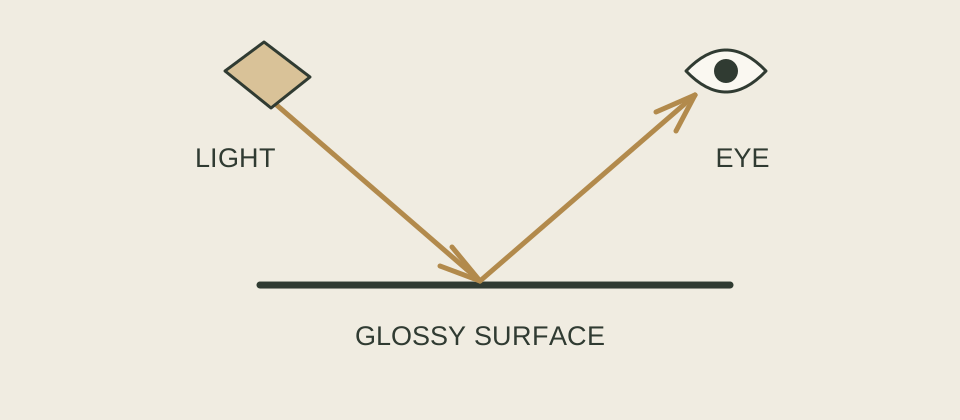 Figure 1.
The relative positions of the light source, surface, and observer can allow reflected light to enter the line of sight.
The arrows explain the principle and do not specify actual installation angles or distances.
Distinguishing Between General Document Work and Product Inspection Conditions
This article addresses situations in office or support areas of medical device companies where documents and work instructions are read.
It does not dictate lighting conditions for visual inspections of product defects, color evaluations, or precision measurements.
Such tasks require distinct conditions tailored to the inspection subject and assessment method.
The required lighting levels for tasks will vary depending on the assignments and should also consider color, contrast, and glare, according to guidelines from the UK HSE.
The Canadian CCOHS also explains that multiple factors, including object size and background contrast, influence visibility during work.
For this purpose, technical materials from international organizations have been referenced.
No legal illuminance standards or suitability assessment criteria will be directly transferred from foreign sources to domestic contexts.
Specific domestic requirements applicable to each task should be confirmed in the field.
Hypothetical Case: White Reflection on a Coated Work Instruction
Let’s assume that two people are reviewing a coated instruction document at a workstation in an office setting.
One person increases the brightness of the desk lamp because they cannot see the text well, yet they still find it hard to read a line in the center of the document due to white reflections.
When the other person asks which part is obscured, the worker indicates a narrow section rather than the entire document.
In this case, the hypothesis to investigate is closer to "the surface is shiny and the reflected light is obscuring the text" rather than "the entire workstation is dark."
They both adjust the desk lamp's position within a normal range and decide to observe the document from the previous reading position again.
This is a hypothetical situation for explanation purposes and does not reflect actual improvements or measurements.
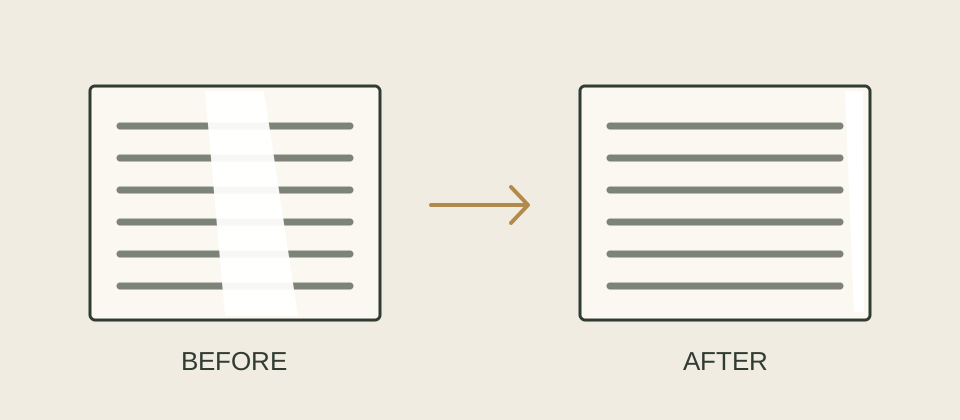 Figure 2.
A hypothetical example comparing the position of reflections obscuring the same text line.
The right side shows the desired change being reviewed, and it does not imply that a particular placement will yield the same results in all workstations.
Keeping Records Connecting Causes and Actions
The following table is a practical suggestion from MedQraft, transferring the previous case to a site review record.
Observed facts, proposed changes, and items to verify after changes are written in different columns.
This differentiation clarifies what has been changed and what has resulted, in a way that is more precise than simply stating "lighting improvement completed."
| Observed Condition | Proposed Change | Verification After Change |
|---|---|---|
| A white reflection appears over a specific line of text | Repositioning the adjustable light source | Whether the line is visible from the same position |
| Incoming light from a window shines on the document | Light shielding and workstation layout | Whether the same issue occurs at different times |
| Reflections are especially pronounced on the coated surface | Considering a matte surface, if permissible for use | Maintenance of document protection, cleaning, and other existing functions |
| Leaning to one side to avoid reflection | Relative positions of light source, document, and worker | Whether it can be read in a comfortable posture |
Approaches to review angle or light shielding are discussed in HSE technical material.
Reducing surface gloss is among the review considerations suggested by the CCOHS.
However, removing coatings or changing materials can affect document durability and cleanability, so the proposed changes in the table should be judged alongside the usage conditions of that document.
Adjustments to fixed lighting installations or electrical work are not included in the range of arbitrary adjustments.
After Reducing Reflections, Check Brightness and Posture Together
Even if the white reflections have decreased in the hypothetical case, if the text itself has become dimmer or requires the worker to look down more, it would be difficult to finalize the proposed change.
The HSE emphasizes the importance of a lighting condition where the worker does not have to squint or adjust posture to see the workpiece, stating that shadows, reflections, and glare can cause discomfort in posture.
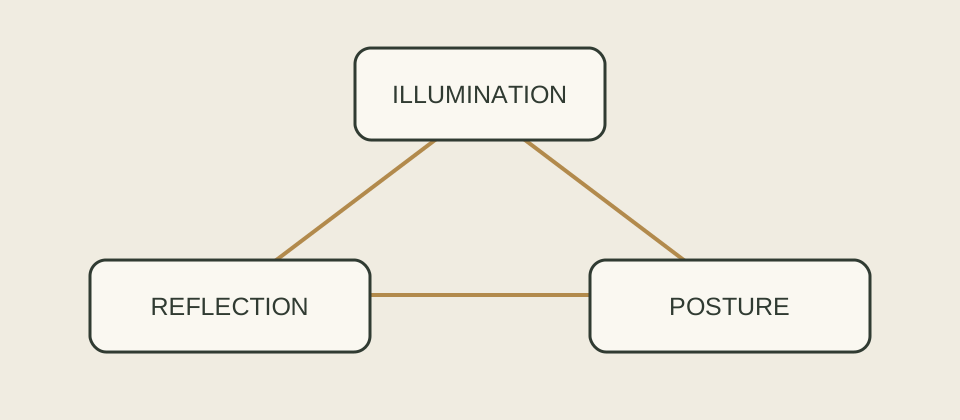 Figure 3.
The three items to review after placement changes.
A scorecard assessing the suitability of the entire workstation based solely on the improvement of one item is not adequate.
The records should capture whether the same document and normal work posture were utilized, whether the change was in light source position or document angle, as well as whether any other lighting conditions or window states changed.
If multiple conditions were altered simultaneously, it becomes difficult to pinpoint the cause of decreased reflection.
Photographs can serve as supplementary materials to explain arrangements and reflection positions, but should not be used to estimate illuminance values based solely on their impressions.
Three concluding review questions are sufficient: Is the line that was hard to read now visible? Is the necessary brightness for reading maintained? Are worker postures changing to avoid reflections?
If the observations do not clearly identify the cause or if issues arise repeatedly in multiple locations, it is often appropriate to proceed to a professional investigation of the lighting environment.
Related Articles
- Choosing Personal Protective Equipment After Reducing Work Risks: You can connect this with the order of reviewing the causes in the work environment.
Source and Verification Scope
Official original text verification date: 2026-10-07.
Tables and figures in the body were created independently.
Original images and tables were not reproduced.
- CCOHS, Lighting Ergonomics: Survey and Solutions.
Body revision date: 2025-08-11.
Technical explanations regarding illuminance, glare, and surface illumination were referenced. - HSE, Lighting, thermal comfort, working space, noise and vibration.
Page notation date: 2025-04-04.
References were made for lighting review per task and glare management. - CCOHS, Lighting Ergonomics: General.
Body revision date: 2025-07-10.
Factors affecting visibility during work were referenced. - HSE, Improving the physical environment.
Update date: 2025-03-25.
Perspectives on posture, reflection, and lighting from the Vision and lighting section were referenced.
Let's talk
Apply what you have read
to your product.
Tell us your product's current stage and the questions you need to review.
Discuss your questions ↗