
MedQraft
← All insights
Medical device research

From Electrical Stimulation to Drug Delivery: Reading a Bioelectronic Wound-Dressing Study

Device architecture, HPLC delivery rates, a pig study and development verification lessons from an integrated bioelectronic wound dressing.

Last regulatory review: 2026-10-21 Rev. 1.0 8 min read

Combining functions in one device makes the transition between functions and the actual output important.
This study integrates electrical stimulation and drug delivery in a flexible wound dressing.
Changing the solution in a microfluidic channel enables sequential use.
From a device-development perspective, the contact interface, fluid pathway and electrical drive should be read alongside the tests used to characterize them.
[1]

Scope of the research

Kaelan Schorger, Hsin-ya Yang, Sujung Kim and colleagues published A multi therapy bioelectronic wound dressing in npj Biomedical Innovations on April 7, 2026.
This is an original Article in a peer-reviewed journal.
We reviewed the main text, including Results, Discussion, Methods and figure captions.
The paper describes a research prototype and an exploratory pig study, not established human clinical efficacy or regulatory approval.
Here, integration refers to the combination of technologies, not a determination of Korean legal product classification.
[1, 2]

Flexible contact interface and external control module

The wound-contact dressing is flexible; the controller, battery and pump are external.
Different solutions supplied through its channels change the operating mode.
Fluoxetine was used for drug delivery.
Describing the complete system as a single thin wireless patch would omit the external modules and connections.
[1, Figs. 1 and 2]
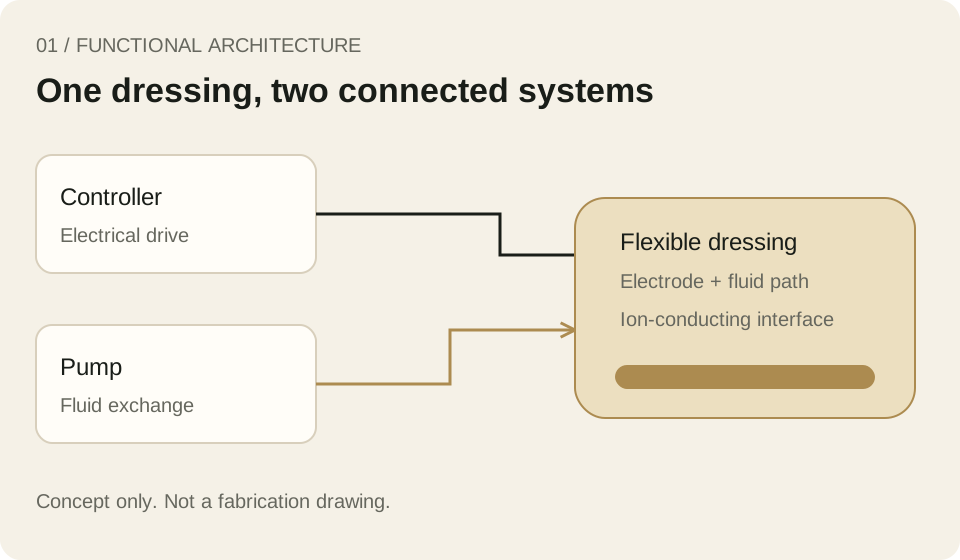
Conceptual electrical and fluid connections between external modules and a flexible dressing
Our own functional schematic.
Dark lines indicate electrical connections and gold lines indicate fluid pathways.
It does not reproduce actual component dimensions, placement or wound geometry.

A development review can trace three paths separately: the electrical path from command to electrode, the fluid path to the contact interface, and the mechanical interface with tissue.
A functioning electrical path does not establish the absence of blockage, detachment or leakage elsewhere.
This is MedQraft's review perspective, not a claim that the study tested every failure condition.

Changing modes does not eliminate residual delivery

Electrical stimulation preceded drug delivery.
Demonstrating that sequence does not establish that it is optimal in all circumstances.
Testing the reversed sequence or each function alone would address different questions.

In vitro HPLC measurements showed mean delivery rates of 10.40 μg/h in ON mode and 3.42 μg/h in OFF mode (n=5).
ON used a target current of 20 μA; OFF used a voltage setting of −0.1 V.
OFF must not be described as disconnection from power.
Diffusion-related delivery remained in that mode.
[1, Fig. 3E and main text]
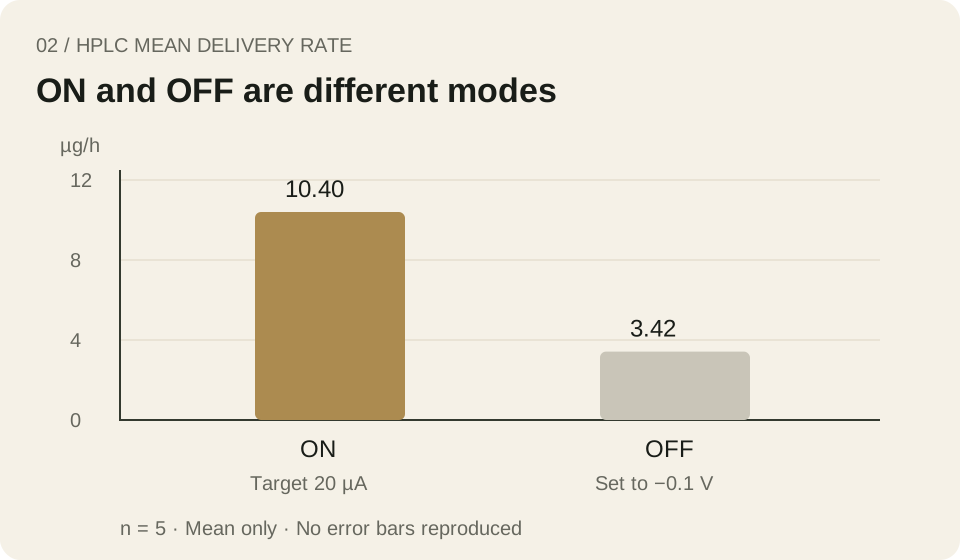
Mean HPLC delivery rates: ON 10.40 and OFF 3.42 micrograms per hour
Our own comparison using the paper's stated mean values (n=5).
ON: target current 20 μA.
OFF: −0.1 V.
Error bars and individual observations are not reproduced.
These are not doses measured directly in wounds.

The vertical axis is delivery rate, not cumulative amount.
A roughly threefold difference in rate does not mean a threefold total dose or therapeutic effect.
Cumulative delivery also depends on duration and transitions.
Residual delivery after a stop command raises a requirements question: what exactly does stopping mean for the product?

Read wound area with the unit of analysis

The final analysis included five device-treated wounds and six control wounds in two pigs.
One detached device was excluded.
Figure 4E shows mean wound area relative to initial area, with SEM.
Between-group differences at individual measurement days were not significant; the analysis across the study period reported p=0.0145. [1, Fig. 4E]
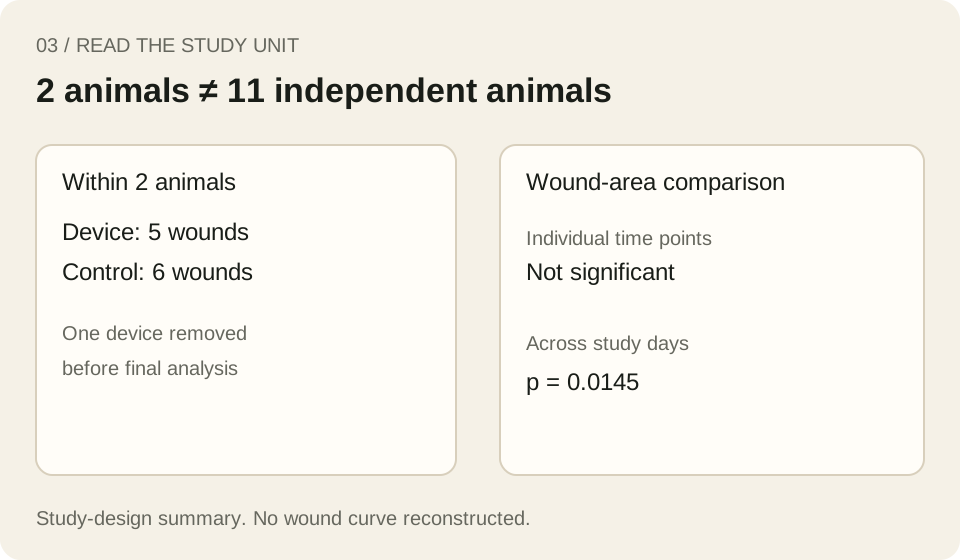
Two animals containing multiple wounds, with per-day and overall analyses distinguished
Our own schematic distinguishes animal count from wound count and individual-timepoint analysis from analysis across the period.
It does not reconstruct the original wound-area curves.
See Figure 4E of the paper for those curves and SEM.

Wounds in the same animal share physiological conditions.
Counting wounds as independent animals overstates the study scale.
Likewise, a result across time must not be presented as superiority on a particular day.
Denominators, error bars and units of analysis matter alongside curve height.

The study did not include parallel electrical-stimulation-only and drug-only groups.
It offers exploratory findings for the integrated device, but cannot separately establish each function's contribution or synergy.
Some descriptions of dressing replacement timing in the text were not clearly consistent, so this commentary does not reconstruct a detailed treatment schedule.

A hypothetical development review

Suppose a development team writes: pressing Stop stops drug delivery.
An OFF entry in the control log can support execution of the command, but the absence of drug transport requires separate measurement.
Define whether stopping means interrupting current, changing mode, reducing delivery rate, or limiting residual amount over a specified period before interpreting the test.

Review target Evidence to examine Distinction to retain
Mode change Command, output and fluid-change records Executed command versus contact-interface state
Stop mode Time-resolved residual delivery Setting versus actual transport
Retention Connections, fixation and detachment records Normal-operation data versus failures during use
Combined functions Single-function and combined conditions Overall effect versus each function's contribution

These are our review suggestions, not a standard prescribing acceptance limits or test counts.
An actual plan needs criteria appropriate to intended use, risk and measurement performance.

Sources and review limits

  1. Schorger K, Yang HY, Kim S, et al.
    A multi therapy bioelectronic wound dressing.
    npj Biomedical Innovations 3, 26 (2026).
    Published April 7, 2026.
    DOI: 10.1038/s44385-026-00081-x.
    Publisher full text and original figures, PMC, PubMed.
  2. Journal author and referee information, editorial policies.
  3. Crossmark document status.
    No correction or retraction notice was found within the checks performed on October 21, 2026.

The article license is CC BY 4.0. Commercial use and adaptation require compliance with attribution, license and change-notice conditions.
Our illustrations are newly drawn rather than copies of the paper's photographs or figures; Figure 2 uses its reported means.
Supplementary material access was not completed and is excluded from the full-text review claim.
Checked October 21, 2026.

Related: DMA instrument principles and graph interpretation, connecting the distinction between measured output, axes and measurement conditions across different technologies.

Let's talk

Apply what you have read
to your product.

Tell us your product's current stage and the questions you need to review.

Discuss your questions ↗
MedQraft / Let's talk

Project inquiry

Start with your challenge.
We will work through it together.

Tell us your product's current stage and the support you need.
We will review the questions and define a suitable scope of support.

Contact@medqraft.co.kr ↗
Information: name, company, email, inquiry and service of interest · Purpose: responding to your inquiry · Retention: until the inquiry is resolved Read the privacy policy
Privacy policy

MedQraft / Privacy

Privacy policy

MedQraft processes only the information needed for website inquiries.
We delete the collected inquiry information when the inquiry is resolved.

Effective date: September 18, 2026

1. Scope and purposes of processing

This policy applies to visits and business inquiries at www.medqraft.co.kr.
We process personal information to review and respond to inquiries, discuss the scope of support, and operate the website reliably.
Customer business data stored in Q-Atelier is governed by the relevant service agreement and separate notices.

2. Information collected and retention

Required information
Name, email address and inquiry
Optional information
Company, selected service of interest, and contact or business details you provide in your inquiry
Collection methods
Website inquiry forms and email inquiries
Basis for processing
Consent to collection and use provided through the inquiry form.
Where necessary to fulfill a request relating to the formation or performance of a contract, we process information on the applicable legal basis.
Retention period
We retain inquiry information until the inquiry is resolved, then delete it without delay.
If information becomes part of a separate contract, we separately explain the required information and retention period.
Where retention is legally required, only the relevant information is stored separately.

You may decline to provide required information, but this will prevent submission of the website inquiry form.
You can make an inquiry without providing optional information.
Do not submit sensitive information unnecessary for the inquiry, such as national identification numbers or patient information.

3. Service providers and external services

Inquiries are forwarded from the website server through an email delivery service to our company mailbox.
We do not maintain a separate inquiry database in this processing workflow.

Vercel Inc.
Website hosting, server-side inquiry processing, operations and security.
Technical information such as IP address, request time, browser and request details may be processed.
Plus Five Five, Inc. (Resend)
Delivery of inquiry notification emails containing name, email, company, service of interest and inquiry details, and management of delivery logs
Gabia Hiworks
Receipt, storage and replies to inquiries in our company mailbox

We do not sell inquiry information or provide it for advertising purposes.
We do not disclose it for an independent third party's purposes unless there is a lawful basis, such as a legal requirement or separate consent.

4. Overseas processing and storage

Overseas cloud services are used to process website requests and deliver emails.
Information entered in an inquiry is transmitted over an encrypted connection upon submission.

Vercel Inc. / United States
Information is transmitted for inquiry request processing and hosting.
Privacy contact: privacy@vercel.com.
Operational records are subject to the retention periods of the services and settings used and Vercel's processing policies.
Vercel data processing information
Plus Five Five, Inc. (Resend) / United States
Information is transmitted upon submission to deliver the inquiry email and manage delivery records.
Privacy contact: privacy@resend.com.
Resend's published default retention period for emails and logs on its standard plans is 30 days.
Earlier deletion may be requested from the provider.
Resend retention and deletion information

Deleting inquiry emails from our mailbox and deleting technical records held by external providers involve different processes.
You may contact the person listed below about deletion, restriction of processing or overseas processing.
If you do not wish to use overseas processing through the website form, you may email us directly.
The processing policies of the email services used will still apply.

5. Deletion and safeguards

After confirming that an inquiry has been resolved, we delete the email and separately saved copies.
Printed materials, if any, are destroyed by shredding or another method that prevents reuse.
Where deletion of information held by an external processor is necessary, we submit a request through that provider's deletion procedure.

Access to personal information is restricted to staff who need it for their work.
We protect information through HTTPS transmission and account access controls.
We do not publish materials containing personal information in public repositories or on public pages.

6. Your rights

You may request access, correction, deletion, restriction of processing or withdrawal of consent by contacting the designated email address.
We will verify your identity to the extent necessary, process the request under applicable law, and notify you of the result.
If we cannot fulfill a request, for example because of a legal retention obligation, we will explain the reason.
For requests made through a representative, we may verify their authority.

7. Access information and external content

We use Naver conversion tracking to measure visits and completed inquiries attributable to Naver search advertising.
Technical information such as the visited URL, referring page, browser and cookies, and whether an inquiry was completed, may be processed.
The name, email, company and inquiry text entered in the form are not included in conversion events.
You can block or delete cookies in your browser.

Server access information may be processed for website delivery and security.
Vercel Web Analytics is used for anonymous visitor statistics on the introduction page and Insights.
Insights statistics aggregate article views, referral sources, countries and device types.
Visitor analytics do not use analytics cookies.
Names, emails, companies and inquiry text from the consultation form are not included in analytics events.
Instagram-specific links use UTM parameters to identify referral sources.
Loading external video or fonts on the website may transmit technical information, including IP address and browser details, to the relevant provider.

You can block or delete cookies and site data in your browser settings.
Some features or external content may be restricted depending on your settings.

8. Privacy officer and contact

Business
MedQraft / Representative: Byeonghwi Kim
Privacy officer and inquiry contact
Byeonghwi Kim
Email
Contact@medqraft.co.kr
Postal inquiries
Suite 222, 56 Geumto-ro 80beon-gil, Sujeong-gu, Seongnam-si, Gyeonggi-do, Republic of Korea (Geumto-dong, Widen Tower)

For privacy-related complaints, you may contact the Personal Information Infringement Report Center or the Personal Information Dispute Mediation Committee for assistance.

9. Changes to this policy

Changes to processing purposes, information collected, retention periods or service providers will be published on this page with their effective date.

September 18, 2026: Website inquiry privacy policy first published

October 14, 2026: Added information on Insights visitor analytics and Instagram referral measurement