
Laboratory Chemical Storage: Two SDS Sections to Connect Before Sorting Alphabetically
This explains how to review the storage location of laboratory chemicals by linking the storage conditions and reaction hazards of SDS.
It covers checking product-specific information, virtual placement cases, and reasoning records.
Organizing chemicals for easy access and storing them safely require different judgments.
If one simply organizes based on alphabetical order, products that should not be in proximity during leaks or container breakage may end up close to each other.
The practical suggestion of this article is to first review the mixed hazards and storage conditions of products, and then apply alphabetical searching and organizing within that context.
The focus is on reagents and chemical products used in testing and analysis laboratories of medical device companies.
This is not a guide for designing a specific storage area for substances or determining legal compliance.
Actual placement must consider products, concentrations, quantities, containers, and facility conditions together.
Reasons to Read Sections 7 and 10 of SDS Together
Section 7 of SDS outlines handling and storage methods, and section 10 details stability and reactivity.
Reading the conditions regarding storage environments and containers in section 7, and connecting them with the substances, conditions to avoid, and reaction hazards in section 10, provides grounds for reviewing the storage locations.
The U.S. OSHA’s standards for SDS composition also include incompatibilities in safe storage conditions, distinguishing unsuitable substances and conditions in stability and reactivity sections.
It is hard to conclude from just a short phrase in one item.
For example, the phrase 'store in a cool place' does not inform one about all the other products that can be safely stored together.
Conversely, one cannot define the suitability of the storage temperature or container based solely on a list of substances to avoid.
 Figure 1.
Reviewing storage conditions and reaction hazards together.
This is not a design for actual chemical combinations or storage areas.
| Section to Read | Content to Link to Review | Records to Keep |
|---|---|---|
| 7. Handling and Storage Methods | Environment, containers, limitations for joint storage | Applicable storage conditions for that product |
| 10. Stability and Reactivity | Substances/conditions to avoid and reaction hazards | Items to contrast with other holdings |
| Product Identification/Composition Information | Whether supply products and data match | Identification information such as product name, supplier, concentration/composition, etc. |
Product Information to Confirm Before Search Results
It is crucial first to confirm that the SDS being used for review matches the products presently held.
Even if the same ingredient name is present, different concentrations, mixed ingredients, and product forms may not facilitate the same storage judgments.
It is practical to secure updated SDS corresponding to supplied products and check the container labels and product identification information in order.
The chemical substance information provided by the Korea Occupational Safety and Health Agency aids in finding and reviewing data.
However, the agency advises that the information is provided as a reference for drafting and reviewing MSDS.
Using data from a single substance as if it were the supplier’s SDS for a mixed product should be avoided.
If the subject of application for the data is ambiguous, it should remain as a matter to confirm with the supplier.
Hypothetical Case: When Products A and B Are Placed Together
The following is a hypothetical case to explain the review process.
A and B are symbols representing actual drug names and do not suggest safe combinations of specific substances.
Assuming that in a newly organized sheet, products A and B are placed contiguously in alphabetical order.
The SDS for A indicates to avoid a group of substances that may correspond to B, and B has separate storage conditions.
The immediate action is not to relocate the two containers but first to confirm product identification and conditions and then review the placement plan.
| Confirmed Situation | Indeterminate Factors | Next Review |
|---|---|---|
| A’s data includes avoidance criteria for specific substance groups | Whether B corresponds to that criterion | Contrast B's composition and product information and clarify ambiguous parts |
| B has separate storage conditions | Whether the existing storage adheres to those conditions | Review facility and container conditions |
| Both products are placed on different shelves | Whether sufficient barriers against potential leaks are in place | Review leakage pathways and necessary separation methods |
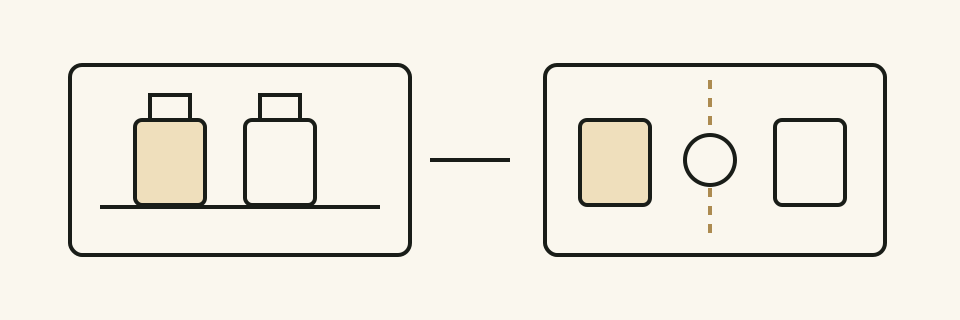 Figure 2.
Separating items on a list and blocking actual contact pathways are not the same.
Distance between figures does not imply necessary separation distance.
The important outcome of this case is not simply 'A and B were separated by a few cells' but rather being able to explain what conditions led to the choice of storage method.
One cannot assume that merely placing on other shelves or using support containers is sufficient.
The actual methods for separation in facilities should be reviewed by on-site safety personnel and necessary specialists.
Alphabetical Order Should Be Used Within the Reviewed Scope
After reviewing placement based on the risk characteristics and storage conditions of products, alphabetical lists can be useful for search and inventory checks.
The key is that the order of the list does not automatically determine the physical storage location.
The product list can link the storage location and the rationale for determining that location.
Here are the review record items suggested by MedQraft:
These do not imply legal forms or obligations that apply to all workplaces.
- Product names, suppliers, and revision information
- Storage conditions confirmed in section 7, and avoidance conditions confirmed in section 10
- Additional comparison items among possessed products requiring further contrast
- Location reviewed and facility conditions, as well as rationale
- Unconfirmed items, person responsible for verification, and completion status
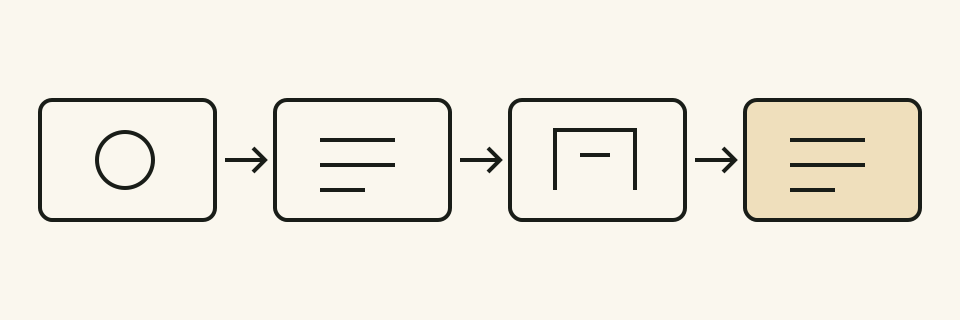 Figure 3.
After confirming the products, conditions, and facilities, record the locations.
Any unverified information remains as unresolved issues, and should not be arbitrarily considered suitable.
Questions Remaining When Reviewing Actual Placement Plans
It is important to determine whether it is acceptable to group differing hazards under a single classification name and whether exceptions for individual products have been overlooked.
One cannot determine the suitability of individual products solely based on large categories or hazard pictograms like ‘acids’ or ‘flammable.’
The review material must explain product-specific conditions in addition to general classifications.
Changes in quantity, container, and facilities may also change the premises of previous location judgments.
When replacing products or introducing new items, it is better to reconsider how the inclusion impacts the products stored together and facility conditions, rather than just adding names to existing lists.
In cases where SDS content is absent or unclear, do not handle it as ‘no restrictions’ but leave it as an item to confirm with suppliers and on-site reviewers.
Handling situations where leaks or breakage have already occurred differs from organizing tasks.
This article’s placement review sequence should not be used as a field response procedure and must be handled according to the emergency response systems of the relevant workplace.
Sources and Scope of Application
Verification date: 2026-10-16.
Original tables and figures were not replicated.
The three figures, hypothetical cases, and review records were created independently.
The explanations of items from foreign materials are not presented as legal obligations for domestic businesses, and separate confirmation of domestic material-specific and quantity-specific facility requirements is necessary.
Confirmed the composition of sections 7 and 10 details.
Used to explain the significance of SDS items based on U.S. standards.
Verification of the reference range of information.
Verification of section 7 'Handling and Storage Methods' and section 10 'Stability and Reactivity' titles.
Related Articles
Environment·Safety published 2026.09.16 If you have an SDS file, check whether it can be accessed on-site.
The safety information of chemicals in research and manufacturing sites does not end with file storage.
This summarizes identification of products, pathways for genuine user access, and virtual cases and on-site verification notes.
Environment·Safety published 2026.10.07 Workplace Lighting: Reviewing Placement When Reflected Glare Obscures Text Explains why documents are difficult to read even on bright work surfaces, divided by illuminance and glare from reflection, and describes how to review placement while maintaining work posture.
Let's talk
Apply what you have read
to your product.
Tell us your product's current stage and the questions you need to review.
Discuss your questions ↗