
Self-Shortening Surgical Sutures: Research into Pressure and Elasticity
This article reviews the development perspective distinguishing movement and pulling force from the research on soft artificial muscle sutures that expand and contract with fluid pressure.
1. The Idea of Introducing Movement into Suture
What kind of design is possible if we think of sutures not merely as fixed-length threads but as small actuators that can be pre-stretched and then shortened? We will review the paper titled Smart surgical sutures using soft artificial muscles, published in 2021.
This is an introduction to an original study applying the principles of soft robotics to sutures, rather than a report on the latest approval news.
The research team presented a prototype that employs soft artificial muscles driven by hydraulic pressure to either tighten loose knots or deploy the fixture.
It is a concept verification study evaluated in excised porcine stomach and colon tissues, and it is not a clinical trial involving human subjects.
This article explains the principles of the device and development perspectives without addressing suture methods or patient treatment guidelines.
2. It Expands When Pressure Increases and Returns When It Decreases
The core structure consists of a silicone microtube surrounded by a metal coil.
When hydraulic pressure is applied inside, the length increases and elastic energy is stored.
A device that maintains the pressure is used to keep the structure elongated, and when the pressure is released, the movement of shortening occurs.
This concept shifts part of the external pulling motion into the material's and structure’s restorative motion.
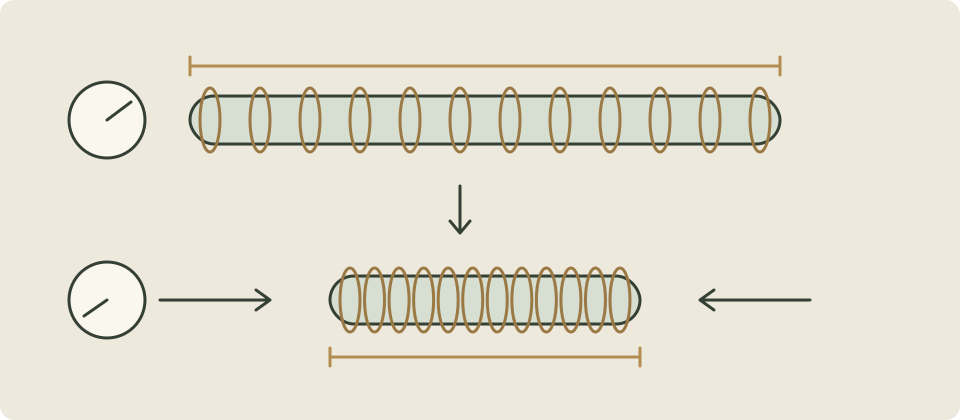
The elastic energy stored in the elongated state leads to contraction upon pressure release.
Here, the expression 'self' does not mean that there is no external energy input at all.
First, there is a stage where the structure is elongated by fluid pressure.
Also, it should not be interpreted that having the contraction principle automatically adjusts the target tension consistently.
The research team also explains the limitation that the final tension is affected by the suturing state.
3. Movement Distance and Pulling Force Are Different Outputs
The following are MedQraft's development perspectives.
Observing how much it shortens when one end is free is possible.
Conversely, under conditions that limit movement, how much force is generated becomes essential.
It is better to separate the questions regarding confirmation of contraction by video from those measuring force with a load cell.
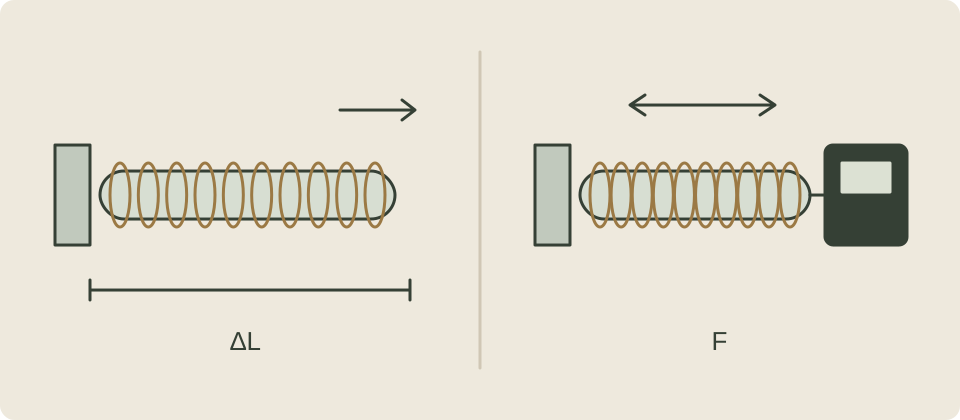
By dividing the length change ΔL and force F, we can distinguish the operation of the actuator from the load characteristics.
| Development Question | Observed Items | Conditions to Specify Together |
|---|---|---|
| How much does it move? | Initial length, final length, movement time | Pressure history, fixed position, external load |
| How much does it pull? | Relationship between force and displacement | Initial stretch, displacement limitation, measurement speed |
| How consistently does it maintain the state? | Changes in length and force over time | Maintenance time, leakage, environmental conditions |
This table is a self-proposed suggestion and does not represent common testing standards or pass criteria.
A design with a high contraction rate is not necessarily advantageous for all applications.
Required movement amounts and forces, as well as deformations permitted by surrounding structures, must be defined first to determine comparability of outputs.
4. What Actually Comparisons Were Made in the Paper
The research team examined the relationship between pressure and elongation using specimens of lengths 30, 45, and 60 mm.
In separate force evaluations, each specimen was pulled at 10 mm/s up to 200% elongation, and the averages of 5 trials per specimen were presented.
This repetition count should not be interpreted as changing to the number of patients or independent 15 specimens.
In the evaluation of fixtures, the team compared structures without fixtures to three fixture designs in excised porcine stomach tissues.
Forces were analyzed for penetration and holding in the opposite direction.
The self-tightening of knots and tissue closure in excised tissues were also demonstrated.
These results show operational feasibility but do not evaluate long-term biological responses or clinical superiority.
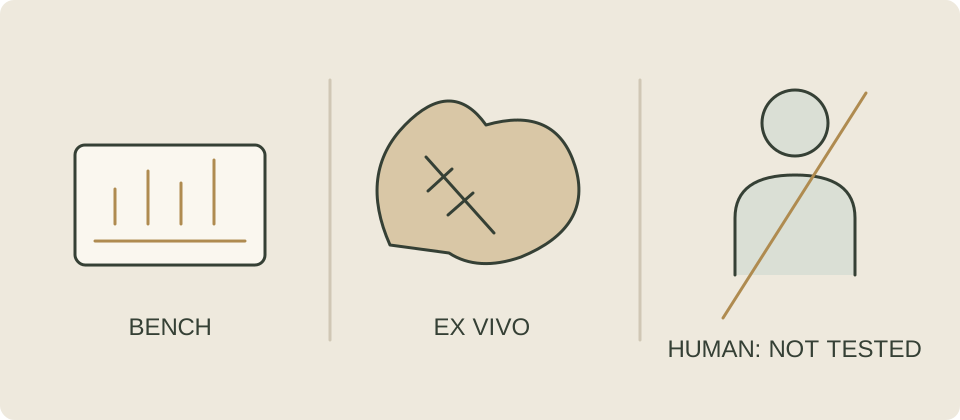
Read to distinguish mechanical evaluations of experimental setups from demonstrations with excised tissues.
No results involving human subjects were reported.
Summarizing the entire paper as a single sample is difficult because evaluations vary between length-based driving assessments, fixture-based force evaluations, and demonstrations within tissues.
When citing results, it is appropriate to attach the subject, conditions, and repetition units of the respective experiments.
5. Virtual Development Conference: Which Output Shall We View First?
The following is a virtual example structured by MedQraft, not experimental results from the paper.
The development team is comparing the shortening of soft actuator components A and B in a video.
A moves more than B.
Force has not yet been measured in this context.
At this moment, if one says ‘A is stronger’, it confuses movement quantity with force.
In the meeting, it is noted first that ‘the quantity of movement when freely moving was compared’.
Then discussion shifts to how the ends will be constrained in actual applications and designs the corresponding force measurements.
| Remarks from the Meeting | More Accurate Content to Record | Follow-up Review |
|---|---|---|
| A appears to move more strongly | The observed video shows A's movement quantity is larger | Decide if force will also be compared under the same load conditions |
| It has no force since it has stopped | Position change has halted. Force was not measured |
Confirm load changes under constrained conditions |
| It’s always the same when pressure is released | Initial state and pressure release conditions are defined together | Record initial length and release history |
This example does not determine the device's performance or criteria for passing.
Clarifying the physical quantities to be compared helps to prevent labeling different phenomena with the same terminology.
6. Limitations of the Research and Next Development Questions
The research team suggests as follow-up tasks, examining the size of the prototype, non-absorbent materials, final tension adjustment, and biocompatibility review.
Long-term performance in living animals and humans is beyond the conclusions of this study.
The prototypes in the paper are not presented as approved products or commercially available devices.
MedQraft's Interpretation: A design perspective to take from this research is that ‘function can be allocated to materials and structure, not just software’.
However, when the structure takes on functionality, variances in materials, bonding conditions, leakage, and repeated use conditions can also affect the output, so it becomes a point of review.
The true examination scope must be defined separately according to the intended use and contact characteristics of the product.
7. Questions to Use When Reading the Next Paper
- What is the input, and where is the stored energy located?
- Are the experiments showing movement and measuring force separated?
- Can you distinguish the count of repetitions from the count of independent specimens?
- Is the comparison target existing commercial sutures or different structures created by the research team?
- Did you distinguish between the research team's observations and claims about follow-up possibilities?
These questions are self-suggested for understanding research as development ideas.
MedQraft's holding of applicable prototypes, execution of tests, or provision of clinical services is not implied.
8. Paper Information, Use Scope, and Related Articles
- Title: Smart surgical sutures using soft artificial muscles
- Authors: Phuoc Thien Phan, Trung Thien Hoang, Mai Thanh Thai, Harrison Low, James Davies, Nigel H.
Lovell, Thanh Nho Do - Journal and Publication Date: Scientific Reports 11, 22420 (2021), November 17, 2021
- Type and Stage: Original research in a peer-reviewed journal, concept verification in experimental setups and excised tissues
- DOI: 10.1038/s41598-021-01910-2
- Full Text: Official Journal Original Article, PubMed Citation
- License: CC BY 4.0. Commercial use and modification are permitted with attribution, as well as conditions for source and license changes.
Third-party materials separately marked with additional rights must be verified.
The original Fig. 1 includes Freepik credits.
This content produced its own illustrations and Korean explanations without replicating figures and tables from the paper.
- Examination Range and Date: October 2, 2026, confirming the introduction, results, discussions, methods, and rights markings of the journal's full text along with PubMed citation.
No corrections or retractions regarding this paper were found during searches in journals or PubMed and DOI.
- Peer Review Information: Introduction to Scientific Reports
Also read: Principles and Research Scope of Photoacoustic Patches, Comparison Conditions for Performance Test Results
Let's talk
Apply what you have read
to your product.
Tell us your product's current stage and the questions you need to review.
Discuss your questions ↗