
Hydrogel Swelling Measurement: Reading Results from Dry Mass and Wet Mass
This article explains the mass-based swelling assessment of bio-based hydrogels through calculation formulas, surface moisture treatment, time-based changes, and comparison conditions using a hypothetical case.
Swelling Results Should be Read Along with Mass Criteria
When a hydrogel absorbs liquid, its mass in the wet state increases.
At this time, the value displayed on the scale may include not only the polymer and the liquid inside but also the liquid left on the surface.
Therefore, it is difficult to judge the material's absorption characteristics by only comparing the mass of the wet sample.
IUPAC explains swelling as the increase in volume of a gel or solid accompanied by the absorption of liquid or gas.
Mass-based evaluation is a method to track these changes by mass.
The rate of mass increase and the rate of volume increase are not the same, so in products where dimensional changes are significant, these two items need to be evaluated separately.
This article addresses mass-based swelling evaluation utilized in the development of bio-based hydrogels.
The structure of the test record is a practical suggestion from MedQraft, and the presented mass and graphs are hypothetical examples created to explain the calculations.
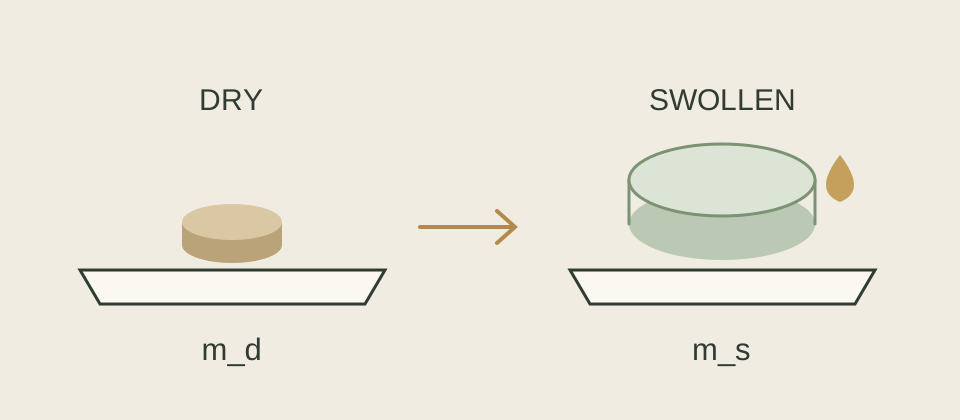
To interpret the wet mass, it is necessary to distinguish between dry mass and the liquid remaining on the surface.
Different Calculation Formulas Yield Different Numbers for the Same Sample
Let us denote the dry mass as m_d and the wet mass at a given time as m_s.
The increase relative to dry mass can be calculated as (m_s − m_d) / m_d.
This definition can also be confirmed in supplemental materials of actual polymer hydrogel studies, where the method of weighing after removing the free water on the surface is specified.
This formula is not the only definition used in the literature.
Hypothetically, if the dry mass was 0.10 g and the wet mass was 0.60 g, the increase would be 0.50 g.
Even with the same measurements, different indicators arise as shown below.
| Indicator | Definition in This Article | Hypothetical Calculation Result |
|---|---|---|
| Increase Relative to Dry Mass | (m_s − m_d) / m_d | 5 g/g |
| Ratio of Wet Mass to Dry Mass | m_s / m_d | 6 |
| Percentage of Increase in Wet Mass | (m_s − m_d) / m_s × 100 | Approximately 83.3% |
Expressing 5 g/g as a percentage translates to 500%.
This differs from the percentage of the increase in wet mass which is 83.3%, as they have different denominators.
Instead of merely writing ‘swelling rate’ in reports, it is more accurate to also include the calculations and definitions of mass.
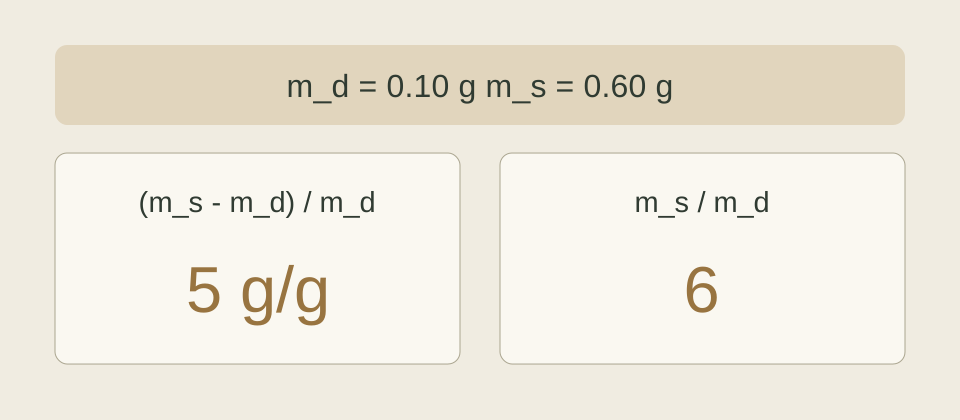
Even when using the same 0.10 g and 0.60 g, the result differs depending on whether the increase or the total mass is divided.
Surface Moisture Treatment Methods Enter Comparison Conditions
As soon as the sample is removed from the solution, if it is wet, the droplets on the surface may also be included in the measurement.
Conversely, if pressed hard or wiped for a long time, it may extrude liquid from within the gel or damage the sample.
It is necessary to establish treatment methods suited to the gel's strength and shape and to verify if they can be consistently performed among workers.
It is suggested to keep specific records regarding the materials used, method and duration of contact, and the time taken from removing the sample to weighing it.
A specific absorption paper or treatment time cannot be universally applied to all hydrogels.
The dry mass should also be obtained under the premise of having established the pre-drying treatment and criteria for determining mass stabilization.
Before treating values obtained through different methods such as freeze-drying and vacuum drying as the same standard, the impact of the methods on the material should be reviewed.
Preparing several independent samples of the same composition in preliminary tests and varying workers and treatment conditions can help determine if handling differences reflect more significantly in the results than inherent material differences.
The number of repetitions and permissible variations should be determined according to the purpose of the test.
Distinguishing Changes Over Time and Equilibrium Values
The wet mass at any given time reflects the state at that moment.
If equilibrium swelling values are referred to without verifying sufficient passage of time, the range of interpretation may widen.
It is advisable to graph results measured over time and identify the intervals where changes diminish, setting criteria for determining both time intervals for judging equilibrium and change quantities before testing.
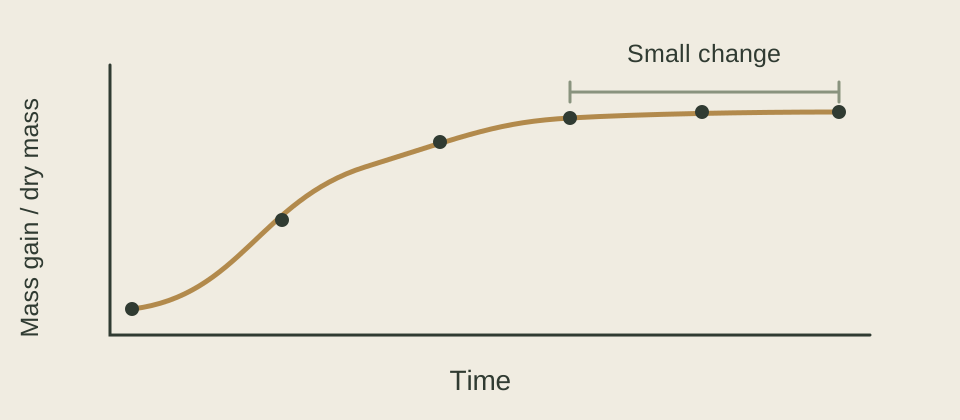
The diminishing change in the latter part is assessed using several points of measurement, not just a single last point to declare equilibrium.
The methods of repeatedly withdrawing the same sample and using separate samples for each time point should be recorded distinctly.
If repeated handling causes damage to the sample or pieces to break away, subsequent values may reflect changes unrelated to swelling.
It is also important to retain a comparison table including solution composition, temperature, sample size, and thickness.
It is crucial not to list the numbers obtained under different conditions as if they were unique ranks of the materials.
Conditions Under Which Increased Mass Can Be Viewed as Absorbed Water
The above hypothetical calculation assumes that solid loss or inflow of other components during the test is negligible.
If actual samples lose polymer or the gel decomposes, it becomes difficult to segregate the absorption amount solely based on changes in wet mass.
The presence of salts or additives in the solution may also affect the interpretation due to residual components after drying.
If such possibilities exist, evaluations can be designed to separately examine the dry mass, elution components, and external appearance post-test.
When using recovered mass after the test, it is necessary to specify the initial dry mass and which value was used in the denominator.
A large swelling value does not necessarily indicate a better bio-based material.
In cases where shape retention or mechanical properties are required, dimensional measurement, compression tests, or rheological evaluations should also be considered.
Items Required for Test Records
| Record Item | Description to Include |
|---|---|
| Sample | Composition, manufacturing batch, size/thickness, identifier of independent samples |
| Dry Standards | Drying method, mass stabilization criteria, measured value of m_d |
| Immersion Conditions | Solution composition, temperature, time, amount of solution and exchange |
| Wet Mass | Surface moisture treatment, time to weighing, m_s by time point |
| Calculations and Interpretation | Formula and units, repetition method, criteria for equilibrium judgment, indication of damage/mass loss |
It is useful to check whether the calculation formula denominator and surface moisture treatment method can be found in the current test record.
When these two items are clear, results from different workers or on different test days can be compared using the same standards.
Sources and Related Articles
Date Verified: October 5, 2026.
The original text below was used to verify terminology and measurement methods.
This is not an article introducing the performance or clinical results of any specific paper, and the figures and tables from the paper have not been replicated.
- [1] IUPAC, Colligative and related properties: swelling definition.
Link - [2] Kimmins et al., Antimicrobial and Degradable Triazolinedione (TAD) Crosslinked Polypeptide Hydrogels, Supplemental Materials p.23, Link, 2021, DOI: 10.1039/D1TB00776A.
Confirmation of dry/swell mass and calculation formulas.
Let's talk
Apply what you have read
to your product.
Tell us your product's current stage and the questions you need to review.
Discuss your questions ↗