
Blood Sugar Claims for a Pain-Relief Device: Reviewing Medical Device Advertising
This article distinguishes between efficacy claims beyond approval purposes using examples from the Ministry of Food and Drug Safety and explains how to verify product information against revised copies of advertising materials.
If a device approved for relieving muscle pain also claims to improve blood sugar, simply changing 'improves' to 'helps improve' does not resolve the issue.
Although the intensity of the expression is reduced, the efficacy conveyed to the consumer remains unchanged.
Before refining the tone in advertising reviews, it is crucial to differentiate what effects are claimed for the product.
Key Points from the Ministry of Food and Drug Safety
On May 2, 2018, the Ministry of Food and Drug Safety introduced types of advertising that claim improvements in blood sugar and other effects from personal low-frequency stimulators approved for muscle pain relief.
The intent is to caution against false or exaggerated advertising that promotes efficacy outside of approved purposes.
This article focuses on expressions related to blood sugar improvement.
It does not present the latest crackdown or recall cases of specific companies.
Official Document from the Ministry of Food and Drug Safety
Even for devices of the same type, it is essential to check the approval details for each individual product.
This example should not be read as implying that all low-frequency stimulators have the same intended purposes.
The actual review targets are the models appearing in advertisements and the approval, certification, and reporting information that applies to those models.
 Figure 1.
This is a conceptual diagram to identify additional efficacy claims by comparing product approval details with advertising.
It does not replicate actual approval documents or advertisements of specific products.
Identifying the Product is Necessary for Comparison
When only receiving advertisement drafts, even if the product names are the same, the models, components, and applicable approval information may be unclear.
When starting the review, ensure that the product introduced in the advertisement matches the internal product information managed.
To avoid misapplying information for different models based solely on the item name, it is useful to compare product name, model name, manufacturer/importer, and approval/certification/reporting information together.
Next, read the intended use of the product and the related performance information, writing down the effects claimed in the advertisement separately.
By dividing the subject, effect, and usage conditions rather than judging the entire sentence at once as 'looks fine,' discrepancies emerge.
'Muscle pain relief' and 'blood sugar improvement' are not merely differences in sentence expression but represent different effects altogether.
The following procedures and record tables are MedQraft’s internal practical proposals.
They do not imply a legal format or universally required submission documents for all advertisements.
Why You Can't End the Review with Just the Phrase 'Helps'
There is a difference in the degree of certainty between 'improves blood sugar' and 'helps improve blood sugar.'
However, both sentences connect the product with blood sugar improvement.
The key point to review in this case is not whether a strong verb was used, but whether unapproved efficacy has been added.
It is not necessary to change this to a rule that bans phrases containing the word 'help.'
One cannot sufficiently understand the relationship between product and efficacy by merely selecting a single word.
One must also consider the omitted subject title, brief descriptions next to images, and captions and subtitles in videos to determine what effect is conveyed.
 Figure 2.
Even if the sentence forms differ, the efficacies conveyed could be the same.
This case examines whether, even after changing to a euphemistic expression, the assertion of blood sugar improvement remains.
Hypothetical Review Table: What to Omit and What to Revisit
Below is a hypothetical example assuming a review of advertisements for a product with a usage purpose of 'muscle pain relief.'
These are not the actual materials of a specific company or advertising review results.
| Review Target | Conveyed Content | Treatment Direction in This Example |
|---|---|---|
| Muscle Pain Relief | Effect linked to the assumed intended use | Examine if it matches actual product data and conditions |
| Help with Blood Sugar Improvement | Efficacy unapproved for the intended use | Delete the efficacy claim and also check related expressions |
| Just changing expression to 'helps with blood sugar management' | Continued implication of the same health effect | Treat it as not enough by just changing words; re-examine the overall context |
| Delete Blood Sugar Related Phrases and Maintain Illustrative Charts | Possibility that the image continues to convey the same effect | Re-examine the connection of chart titles, axes, descriptions back to the product |
The first row does not necessarily refer to a complete phrase that can be posted immediately.
It must be examined alongside the actual approval details, advertising context, and other requirements.
This table particularly focuses on stages to identify efficacy outside of the approval scope.
Review Modifications Together with the Entire Advertisement
If a person in charge deletes one problematic sentence, similar claims may still remain in the title or image descriptions.
Therefore, rather than ending modification requests with ‘delete this sentence,’ it is better to specify which efficacy should be removed.
In revised copies, one should reconnect and read to see if titles, body, graphics, videos, and subtitles conveying the same efficacy remain.
Review records can include product identification information, versions of compared materials, advertisement draft versions, reasons for modification requests, and results of those requests.
Doing this makes it easier to verify whether previously excluded efficacies re-entered when reducing phrases or reusing images for other channels.
Recording items should be determined according to the organization’s review process and scale of work.
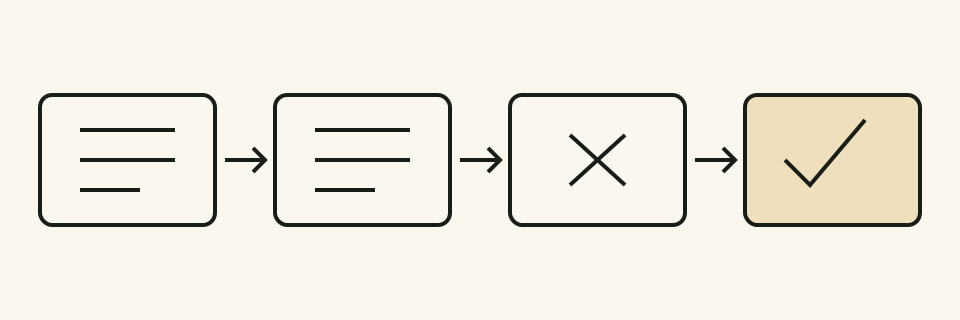 Figure 3.
The internal review flow that starts from product information and returns to the entire revised advertisement.
It does not cover all requirements for legal advertisement reviews.
Questions to Leave at the End of the Review
- Is the product information compared with the currently advertised model the same?
- Can the phrase explicitly explain the claimed effect?
- After changing to a euphemistic expression, are any unapproved efficacy details remaining?
- Even after deleting sentences, do images or videos convey the same effect?
- Is it possible for future reviewers to check which drafts were compared with which materials?
This article explains how to apply publicly available cases to advertising review work.
For final determinations of individual advertisements, current requirements applicable to the products and media must be separately verified.
Past press releases cannot definitively clarify current advertising requirements or whether they should be reviewed.
Sources and Verification Scope
Ministry of Food and Drug Safety, "Providing Safety Information on Food and Medicines for the Month of May," 2018-05-02.
Confirmed examples from South Korea's medical device purchase and use safety information.
Verification Date: 2026-10-16.
Figures, tables, and attachment formats from the original text have not been reproduced.
Comparison tables, review procedures, and explanatory images are created by MedQraft for this article.
The illustrative explanations of examples in the text are delineated distinctly from internal practical proposals.
Related Articles
QMS / ISO 13485 Published on 2026.10.12: How many samples to inspect from 1,000 parts: Compare number of samples and pass/fail criteria by inspection level and AQL using numerical examples from current KS Q ISO 2859-1.
Regulatory Software Published on 2026.10.15: If I entered 10 but it records as 100: Explaining how to interpret injection pump input errors based on a publicly available example of an injection pump error and reviewing input events against display.
Let's talk
Apply what you have read
to your product.
Tell us your product's current stage and the questions you need to review.
Discuss your questions ↗