
ISO 13485 7.3.8 design transfer: production specifications, instructions and evidence
Connect design drawings and bills of materials to production methods, inspection criteria, trial records and transfer decisions under ISO 13485.
Design and development transfer connects approved design outputs to the specifications and methods used in production, with evidence that production can meet product requirements.
Sending a drawing does not establish that assembly methods, process conditions and inspection methods are ready.
The information used by production needs to connect to evidence supporting its suitability.
This article focuses on ISO 13485:2016 clause 7.3.8. Document titles, identifiers, assigned roles and the thermometer scenario below are MedQraft practice examples.
They are not prescribed forms or actual manufacturing results.
1. How design outputs and design transfer differ
Clause 7.3.8 calls for documented transfer procedures, verification that outputs are suitable for manufacturing before they become final production specifications, and production capability that can meet product requirements.
Transfer results and conclusions are retained as records.
The plan and report below illustrate how to organize that work.
Design outputs describe the materials, structure, functions and criteria that implement the design.
Transfer develops those outputs into information that production can use.
A drawing may specify sensor location without fully defining the sequence for placing and securing the part or the method for checking its position after assembly.
| Activity | Decision being supported | Fictional thermometer example |
|---|---|---|
| Design outputs, 7.3.4 | Are the results implementing the inputs clearly defined? | Define sensor position and component specifications in drawings and lists |
| Design verification, 7.3.6 | Do outputs meet input requirements? | Confirm relevant performance requirements under specified conditions |
| Design validation, 7.3.7 | Are requirements for the specified application or intended use met? | Assess evidence appropriate to intended conditions of use |
| Design transfer, 7.3.8 | Is the design appropriately translated for production? | Establish production and inspection methods and examine their application |
These activities use related evidence but support different decisions.
Product performance testing may be complete while the production assembly method remains unresolved.
An instruction may be written before evidence establishes that it is suitable for making conforming products.
Chapter 5 Task 16 of the MDSAP Audit Approach describes examining how a design becomes production specifications.
Transfer can proceed in phases rather than occurring only once at the end of development.
MDSAP AU P0002.011, pp.94–95
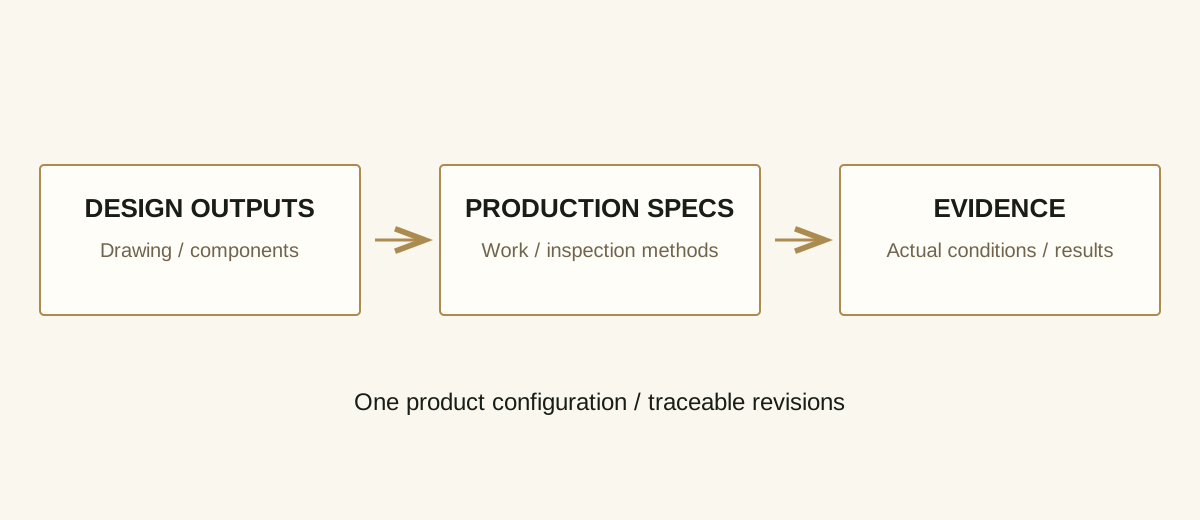
This is a conceptual flow, not a manufacturing procedure.
2. When assembly depends on the developer's hands
In the fictional example, a developer assembles a thermometer prototype while holding its sensor in position.
The product drawing defines the required location, but a method that production personnel can follow has not been established.
A recording of the developer's hand movements alone would not resolve the underlying question: how will the position be maintained and checked during production?
A proposed holding fixture could lead to definitions for locating surfaces, part orientation, assembly sequence and the point at which retention is checked.
Building the fixture does not, by itself, establish success.
Potential component damage, movement after assembly and the operator's ability to access and inspect the part still need consideration.
The evaluation criteria come from approved drawings and product requirements.
The transfer team should not create a more convenient tolerance for the exercise.
If inspection against the existing criterion is difficult, consider the suitability of the measurement method.
If the design criterion itself needs to change, assess the impact and follow the applicable change and approval process.
3. Documents, timing and responsibilities
The table illustrates an organization in which design, manufacturing engineering and quality work together.
Smaller organizations may combine roles or documents.
Completeness of information and responsibility matters more than the number of separately named forms.
| Document or record | Timing and purpose | Example content | Illustrative responsibilities |
|---|---|---|---|
| Transfer plan | Before trial production preparation, define scope and completion criteria | Model and design revision, transfer items, evaluation methods, owners and handling of unresolved items | Design and manufacturing engineering prepare; quality reviews; designated authority approves |
| Production specification set | Before use in the relevant production activity | Assembly drawings, bill of materials, material specifications, revisions and relationships | Design prepares technical content; manufacturing engineering reviews suitability; authorized person approves |
| Work instruction | Establish the trial version before assembly, then revise as justified | Tool identification, part orientation, sequence, in-process checks and response to abnormalities | Manufacturing engineering prepares; design and quality review; document authority approves |
| Inspection criteria and method | Before evaluation, align how conformity will be judged | Drawing requirement, measurement position and timing, equipment and source of acceptance criteria | Quality or test personnel prepare; design reviews; authorized person approves |
| Trial assembly or production record | During execution, preserve actual conditions and results | Personnel, component/tool/instruction revisions, actual conditions, measurements, deviations and rework | Performer records contemporaneously; designated reviewer checks data and deviations |
| Transfer evaluation report | When evidence is assembled for a production-readiness decision | Item-level results, unresolved issues, impact, actions, scope and conclusion | Transfer owner prepares; relevant functions review; designated authority makes and approves the decision |
A useful plan goes beyond “documents available.”
One evaluation item could ask whether production personnel can assemble and inspect sensor position using the specified instruction and fixture.
Link that item to the controlling drawing and inspection method.
Any additional verbal instruction or physical assistance from the developer belongs in the interpretation of the result.
The report should stay within the evaluated scope.
Evidence for one component source, tool configuration or set of working conditions does not automatically cover another supplier or production line.
Transfer approval and release of an individual production lot are separate decisions.
A transfer report does not replace subsequent production inspection and release records.
4. Tracing the drawing through to the transfer conclusion
The following identifiers illustrate a document relationship.
They are not actual controlled document numbers or test results.
| Connection | Example reference | Information retained |
|---|---|---|
| Design basis | DWG-01 Rev.B, BOM-01 Rev.B | Sensor-position requirement S01 and applicable components |
| Production implementation | WI-01 Rev.A, JIG-01 Rev.A | Retention method, assembly sequence and fixture configuration |
| Conformity assessment | IP-01 Rev.A, item S01 | Inspection timing, method and reference to the drawing criterion |
| Execution evidence | TR-01, individual sample records | Revisions used, actual measurements, observations, deviations and rework |
| Transfer decision | DTR-01, item S01 | Record references, assessment against criteria, unresolved items and conclusion |
Suppose TR-01 identifies an additional hand movement that the work instruction did not describe.
The report retains that observation.
The team determines the action, revises the instruction where necessary and defines what to check again.
The new record identifies the revised version and re-evaluation scope while the previous record remains available.
Rewriting the earlier record as though the latest instruction had always been used would remove the basis for understanding the change.
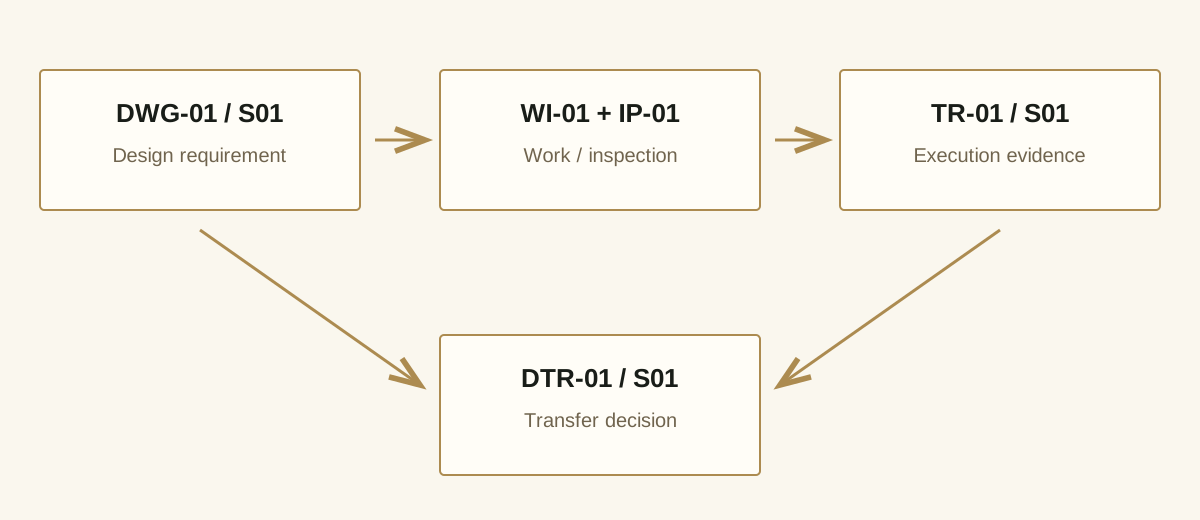
The example links identifiers and revisions; it does not require merging all documents into one file.
5. Controlling instructions and execution records
Document control connects to ISO 13485:2016 clause 4.2.4 and record control to 4.2.5. In transfer work, distinguish information describing what is to be done from evidence showing what actually happened.
MDSAP Chapter 1 Task 8 provides a public audit perspective on these controls.
MDSAP Audit Approach
A practical work-instruction register can link document number, revision, approval status, effective date and location of use.
Personnel need to know which version applies at the workstation.
When a document changes, consider existing printed copies, displayed instructions and training material.
For external component specifications or test standards, retain a clear reference to the edition applied to the product.
An execution record can identify its author, execution date, item tested, actual conditions and location of original data.
Corrections should remain distinguishable from the original entry and follow the organization's procedure for tracing who changed what and when.
Electronic records also call for an operational approach to access permissions, retrieval, backup and recovery.
A retention period cannot be selected from an example document title alone.
Determine the organization's retention rules using product lifetime, applicable regulatory obligations and the standard's record-retention requirements.
Discarding trial records because transfer is complete would make later design-change or manufacturing investigations harder to substantiate.
6. Medical device files and design and development files
Connect the medical device file under 4.2.3 and the design and development file under 7.3.10 according to their purposes.
Decide where production and inspection information is controlled and where the evidence of design activities can be retrieved.
This helps avoid uncontrolled copies that gradually acquire different revisions.
For this example, the medical device file index could reference approved drawings, the BOM, work instructions and inspection methods.
The design and development file could point to the transfer plan, execution evidence, evaluation report, associated reviews and change evidence.
If the actual documents reside in another controlled system, retain their identifiers and retrievable references in the file structure.
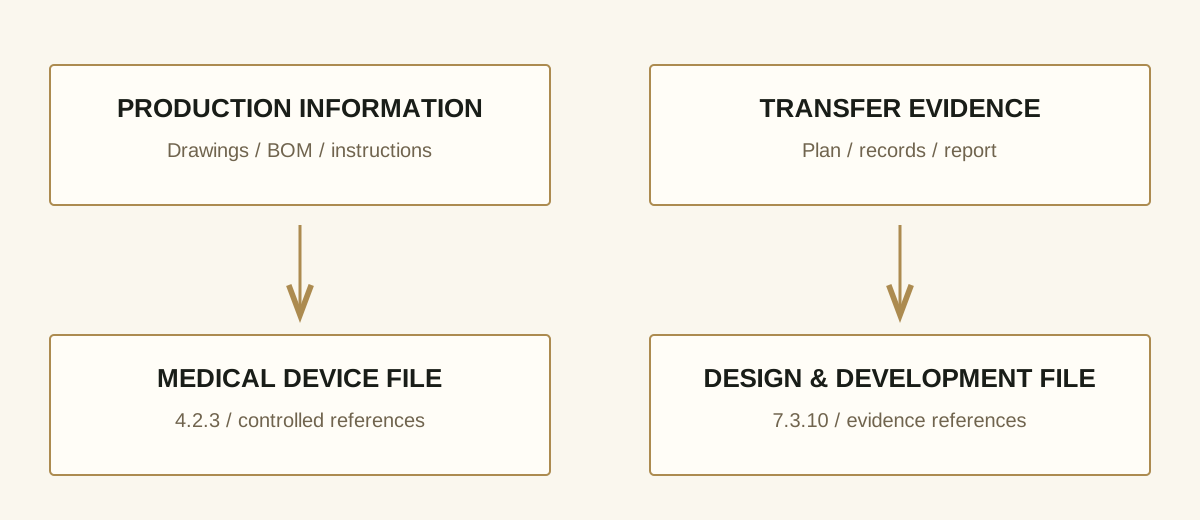
It does not mean that every referenced document must be duplicated in both files.
7. Transfer does not replace process validation
Production and service controls relate to 7.5.1. Clause 7.5.6 concerns validation of processes whose results cannot be, or are not, verified through subsequent monitoring or measurement.
Evaluate that applicability separately during transfer.
A transfer meeting or a single trial assembly does not replace the necessary process validation.
If the fictional product involved bonding, the team would first consider whether visual and positional inspection adequately establishes the required joint properties.
This article does not determine the suitability of any adhesive or bonding process.
The needed evaluation depends on product requirements, risk, process characteristics and what subsequent inspection can establish.
Measuring sensor position also raises questions about measurement capability and equipment control, linked to 7.6. Externally supplied fixtures or components may introduce links to purchasing requirements and acceptance activities under 7.4. Choose controls relevant to the actual transfer rather than listing standards without explaining their purpose.
8. What the production-readiness conclusion should explain
A useful transfer report explains the configuration and conditions evaluated, what was established, and what remains unresolved.
It allows reviewers to understand whether production documents agree with the approved design, whether unplanned assistance or rework was needed, and how remaining issues affect product requirements.
Where issues remain, define the scope of production application and the owners and methods for further evaluation.
An unsupported item should not become “ready” merely because it is assigned to future follow-up.
The decision becomes clearer when the drawing, work method, inspection criteria and execution evidence all refer to the same product configuration.
Sources and scope
- ISO 13485:2016 official information: third edition, published in 2016; the official page identifies confirmation in 2025.
Checked 2026-11-03. - MDSAP AU P0002.011, Audit Approach: revision dated 2026-08-03.
Public audit guidance consulted includes Chapter 5 Task 16, Chapter 1 Task 8 and Chapter 6.
Country-specific additions are not treated as universal ISO requirements.
Checked 2026-11-03.
This is a practical interpretation based on public sources.
Confirm detailed obligations against the applicable regulatory and standard texts and the organization's controlled procedures.
The example document structure and role allocation are not the only possible conforming approach.
Related reading
- Design outputs: results for implementation, production and verification
- Design verification: requirement-level evidence and documents
- Design validation: intended use, plans, records and reports
- QMS insights and the ISO 13485 clause guide
Continue through ISO 13485 clauses
Compare clause purposes and supporting evidence
- 7.3.2 Design and development planning
- 7.1 Planning of product realization
- 7.2 Customer-related processes
- 7.3.3 Design and development inputs
- 7.3.4 Design and development outputs
- 7.3.5 Design and development reviews
- 7.3.6 Design and development verification
- 7.3.7 Design and development validation
- 7.3.9 Design and development changes
- 7.3.10 Design and development files
- 7.4.1 Supplier evaluation
- 7.4.2 Purchasing information
- 7.5.6 Validation of production and service processes
Let's talk
Apply what you have read
to your product.
Tell us your product's current stage and the questions you need to review.
Discuss your questions ↗