
ISO 13485 7.3.10 design and development files: linking configurations to evidence
Connect device configurations, drawing revisions, specimens, test results and change decisions.
Understand design file indexes, controlled references, responsibilities and related document controls.
A design and development file makes the evidence behind a device design and its changes retrievable.
Finding a test report is only a starting point: the reader also needs to identify the tested configuration and understand how that evidence relates to the device under review.
This article explains ISO 13485:2016 clause 7.3.10 through a fictional thermometer example.
Document names, identifiers, configurations and role assignments below are practical suggestions, not prescribed forms or actual test results.
1. The scope of a design and development file
Annex 1 of the official MDSAP Audit Approach describes a file maintained for each medical device type or family, containing or referencing records that demonstrate conformity with design and development requirements and records of design changes.
The emphasis is on evidence, not a particular folder or single-PDF format.
MDSAP AU P0002.011, Annex 1, page 144
In practice, define the scope before building the index.
Identify the models and variants covered, distinguish shared evidence from model-specific evidence, and state which development stages and changes are represented.
A family-level file does not, by itself, establish that one set of evidence covers different sensors or software configurations.
A configuration-based index is one implementation option.
It does not mean clause 7.3.10 prescribes a separate file for every product version.
A family file with explicit applicability fields, or controlled relationships within a document system, may serve the same practical purpose.
2. Follow the specimen identifier to the configuration
In the fictional TH-01 thermometer, relocating the sensor changes configuration A to configuration B.
Report TR-01 identifies specimen S-01.
Its build record identifies drawing DWG-01 Rev.A, while the current configuration B uses Rev.B.
Relabelling TR-01 as evidence for the current product would obscure what was actually tested.
Instead, retain its association with configuration A and link configuration B to the relevant change assessment and evaluation records.
Where earlier evidence remains applicable, include the justification and its limits.
This article focuses on retrieving completed activities and decisions, rather than deciding the extent of additional testing.
| Starting item | Example reference | What the relationship establishes |
|---|---|---|
| TH-01 configuration B | DWG-01 Rev.B | The design configuration being considered |
| DWG-01 Rev.B | Specimen S-02 build record | Which drawing and components define the tested item |
| Specimen S-02 | Plan VP-02 and execution record TR-02 | Planned methods, conditions and criteria, and actual execution |
| Execution record TR-02 | Results report VR-02 | Raw data, requirement-level conclusions, deviations and follow-up |
| Change CHG-01 for configuration B | Assessment and review/approval record CR-01 | The evidence considered and the scope of the decision |
These identifiers illustrate relationships only.
No passing result or completed approval is assumed.
An index can distinguish draft, under review and approved status, with unresolved items and their owners visible.
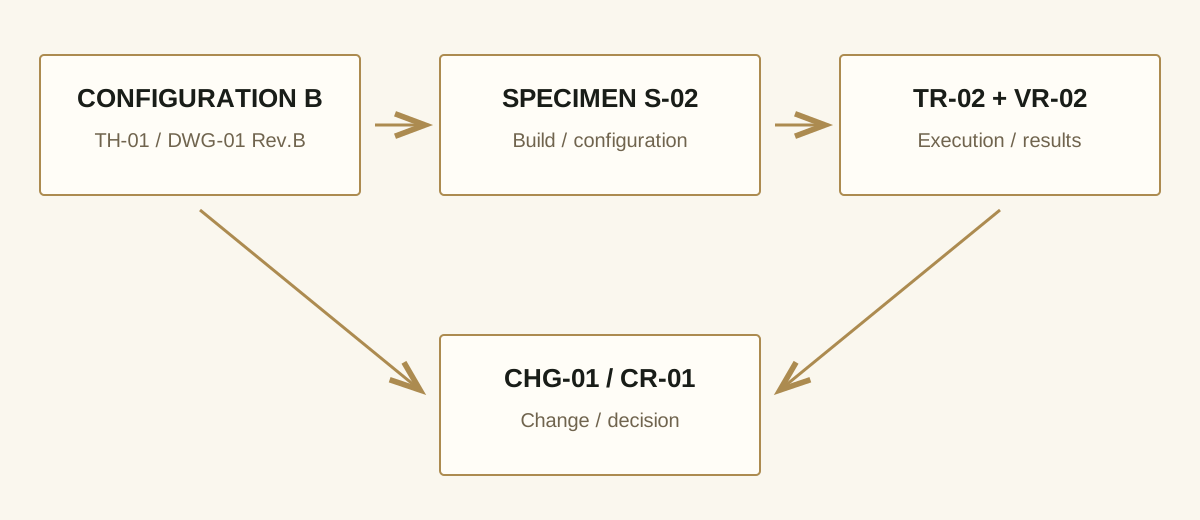
Figure 1.
An illustrative route from configuration B to the tested item, results and change decision.
Arrows represent references, not a passing result or completed approval.
3. Documents, purposes and update points
Starting the collection only at project closure can make it difficult to reconstruct the configuration and context of earlier work.
A practical approach is to define the index during planning and update relationships as activities and their records progress through review.
The following names are examples; one controlled document may perform several of these functions.
| Example document or record | Purpose and useful contents | When to create or update the relationship |
|---|---|---|
| Design file index | Covered models/family, IDs and revisions, original location, applicability, status and owner | Start during planning; update at stage transitions and changes |
| Development plan | Activities, responsibilities, stage relationships and planned reviews/evaluations | At project start and planning changes; connect to execution records |
| Input requirements and traceability table | Requirement IDs, sources, conditions, related outputs and evidence | When requirements are defined or changed |
| Drawings, bill of materials and software configuration information | Identification of the implemented design | At configuration release or revision; connect to specimens and production information |
| Design review record | Reviewed material and revisions, participants, conclusions and actions | At the review; retain links to action outcomes |
| Verification/validation plans, execution records and reports | Purpose, target, conditions and criteria; actual work and raw data; conclusions | Plan before work, record during work, evaluate afterwards; align the identified target throughout |
| Transfer evaluation record | Specifications transferred, supporting evidence and outstanding actions | During transfer activities and decisions; link to production revisions |
| Change request, assessment, approval and implementation records | Before/after configurations, rationale, evidence and implementation scope | Across the change lifecycle; preserve the relationship to earlier evidence |
Assign authorship to someone who knows the work performed, technical review to people able to assess the evidence, and approval to the role authorised by the organisation's procedure.
Quality personnel may check the control process and accessibility without automatically replacing technical judgement.
These are suggested responsibilities, not universal job titles or a mandatory signature chain for every document.
4. A reference must lead to an identifiable original
“See test folder” is often too broad for another person to find the same evidence.
A practical index includes the document ID, revision or issue identifier, applicable configuration, status and controlled original location.
Check that the filename and the identifier inside the document agree.
For example, VR-02 / Rev.1 / TH-01 configuration B / under review communicates scope and status.
A filename such as final_latest.pdf does not.
A hyperlink is not approval evidence; it should lead to the actual approval information where that information is needed.
When an external laboratory holds records, clarify access permissions, what will remain available after the contract ends, and which report attachments or raw data are included in the agreed deliverables.
Plan for expired sharing links and departing account owners.
Useful local controls include:
- Update references when originals move and check affected links.
- Distinguish approved copies from work in progress and preserve the revision used for earlier decisions.
- Define a correction method that preserves the original entry and identifies the reason, author and time of correction.
- Define access, backup and recovery arrangements, then test retrieval using the permissions of the intended reader.
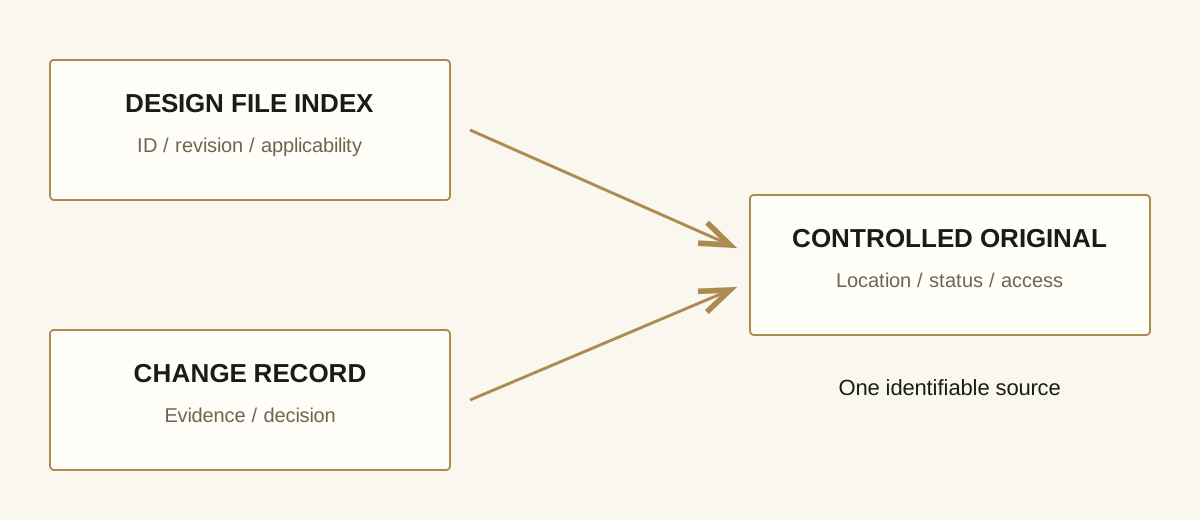
Figure 2.
A design file index and change record can refer to the same controlled original.
The example emphasises identification and accurate references rather than creating additional uncontrolled copies.
5. Medical device files and design files answer different questions
Clause 4.2.3 and clause 7.3.10 may share references but serve different purposes.
MDSAP Annex 1 describes medical device file information such as device descriptions, specifications and relevant manufacturing, packaging and storage information alongside design and development evidence.
MDSAP Annex 1, page 144
| File | Practical question | Example references |
|---|---|---|
| Medical device file, 4.2.3 | What information defines how this device is provided and controlled? | Device description, applicable specifications, manufacturing and inspection information |
| Design and development file, 7.3.10 | Where is the evidence supporting this design and its changes? | Development results, review records, test evidence and change records |
Both may reference the same approved drawing.
Finding that drawing in the medical device file does not explain all evidence supporting its requirements or change history.
Similarly, collecting reports does not define the production specifications that personnel should use.
Establish the questions each index must answer before duplicating documents.
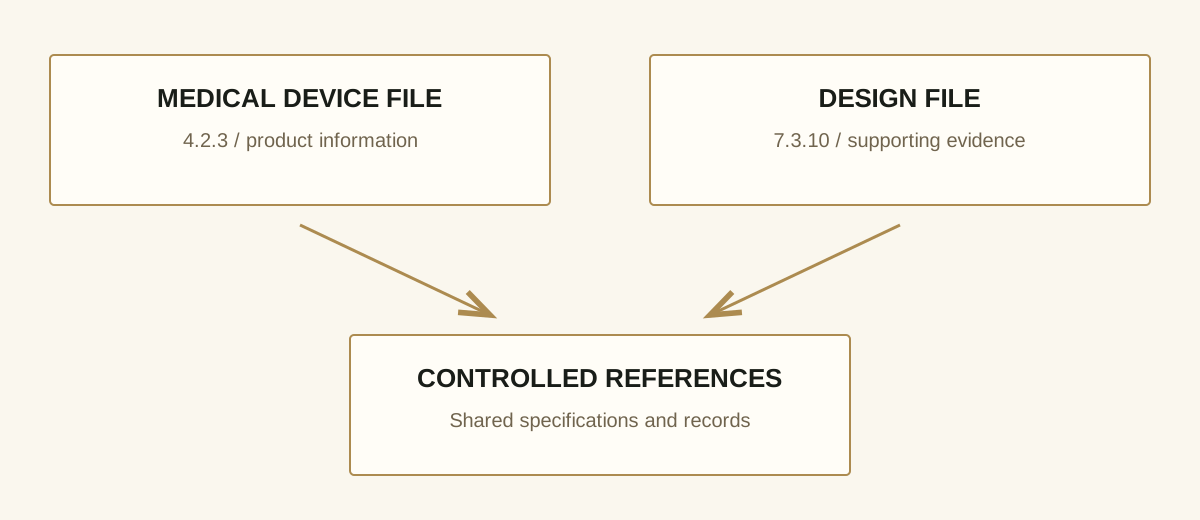
Figure 3.
Product information and design-decision evidence have different purposes and may share controlled references.
The illustration does not require physically separate storage.
6. Connect the index to document and record controls
The MDSAP document and record control task addresses internal and external QMS information and references ISO 13485:2016 clauses 4.2.4 and 4.2.5. It identifies obsolete procedures in use and unavailable required records as examples of ineffective controls.
MDSAP Chapter 1 Task 8, pages 28 to 29
For index operations, distinguish the instructions intended for future use from evidence of work already performed.
Manage the approval and applicable revision of a revised plan or drawing.
Preserve the actual configuration and plan used for an earlier test instead of retrospectively substituting the latest revision.
A revised plan should not make it impossible to reconstruct the basis of earlier work.
Retention is not an arbitrary setting chosen by the index author.
Determine it through the organisation's device-lifetime definition, applicable standards and market-specific regulatory requirements, and document the resulting controls.
MDSAP includes additional country-specific conditions; do not apply one assumed period to every product and market.
External storage contracts and system migrations should also preserve the required retention and retrieval capability.
7. Walk through one configuration
The following is a practical MedQraft check, not a prescribed audit sample size or test procedure:
- Select a model and configuration, then identify its drawings, components and software information.
- Select an important requirement and follow the reference to its evaluation evidence.
- Compare the specimen, configuration, plan, method and conditions identified in that evidence.
- Locate the conclusion, relevant approval and status of unresolved items.
- If a change occurred, follow the relationship between earlier and later evidence and its applicable scope.
- Check that another intended user can open the same original, and correct broken references.
An index may still reveal missing evidence or an unexplained applicability boundary.
Distinguish a missing record from an activity that was never performed and determine the appropriate action.
Adding a link is not a substitute for resolving the underlying gap.
Traceable records make a decision retrievable; they do not independently establish that the decision was technically sound.
Related reading
- Design verification and objective evidence
- Design validation and intended use
- Design transfer and production specifications
- Design change impact assessment
- Quality systems insights and clause guide
Sources and application
The standard discussed is ISO 13485:2016.
This explanation uses the public MDSAP AU P0002.011 Audit Approach, revised 3 August 2026: Annex 1, page 144; Chapter 5 Task 4, page 79; and Chapter 1 Task 8, pages 28 to 29.
Checked 5 November 2026.
MDSAP audit explanations are not a substitute for the complete official standard and applicable market requirements.
Document structures, responsibilities and fictional relationships in this article are MedQraft's implementation suggestions.
Continue through ISO 13485 clauses
Compare clause purposes and supporting evidence
- 7.3.2 Design and development planning
- 7.1 Planning of product realization
- 7.2 Customer-related processes
- 7.3.3 Design and development inputs
- 7.3.4 Design and development outputs
- 7.3.5 Design and development reviews
- 7.3.6 Design and development verification
- 7.3.7 Design and development validation
- 7.3.8 Design and development transfer
- 7.3.9 Design and development changes
- 7.4.1 Supplier evaluation
- 7.4.2 Purchasing information
- 7.5.6 Validation of production and service processes
Let's talk
Apply what you have read
to your product.
Tell us your product's current stage and the questions you need to review.
Discuss your questions ↗